Ch.10 - Structure and Synthesis of Alcohols
Wade - Organic Chemistry 9th Edition
Wade9th EditionOrganic ChemistryISBN: 9780135213728Non è quello che usi tu?Cambia libro di testo
Capitolo 10, Problema 35a

Predict which member of each group is most soluble in water, and explain the reasons for your predictions.
a. butan-1-ol, pentan-1-ol, or propan-2-ol

Guida verificata passo dopo passo
1
Step 1: Understand the concept of solubility in water. Solubility in water is influenced by the ability of a molecule to form hydrogen bonds with water. Molecules with polar functional groups, such as hydroxyl (-OH) groups, can form hydrogen bonds, increasing their solubility.
Step 2: Analyze the molecular structures of the compounds. Butan-1-ol, pentan-1-ol, and propan-2-ol all contain a hydroxyl (-OH) group, which can form hydrogen bonds with water. However, the solubility is also affected by the size of the hydrophobic (nonpolar) alkyl chain.
Step 3: Compare the alkyl chain lengths. Butan-1-ol has a four-carbon chain, pentan-1-ol has a five-carbon chain, and propan-2-ol has a three-carbon chain. Longer alkyl chains increase the hydrophobic character of the molecule, reducing solubility in water.
Step 4: Consider the branching in propan-2-ol. Branched molecules, like propan-2-ol, tend to be more soluble in water than their straight-chain counterparts because branching reduces the effective hydrophobic surface area.
Step 5: Predict the order of solubility. Based on the above analysis, propan-2-ol is expected to be the most soluble in water due to its shorter chain and branching. Butan-1-ol is next, followed by pentan-1-ol, which has the longest and least soluble alkyl chain.

Risposta video verificata per un problema simile:

Questa soluzione video è stata consigliata dai nostri tutor come utile per risolvere questo problema.
Durata del video:
6m

Concetti chiave

Ecco i concetti essenziali che devi comprendere per rispondere correttamente alla domanda.

Hydrophilicity and Hydrophobicity

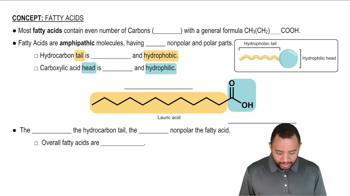
Hydrophilicity refers to the affinity of a molecule for water, while hydrophobicity indicates a lack of such affinity. Molecules with polar functional groups, such as alcohols, tend to be hydrophilic due to their ability to form hydrogen bonds with water. In contrast, larger hydrocarbon chains contribute to hydrophobic characteristics, reducing overall solubility in water.
Video consigliato:
Percorso guidato
2:00
Fatty Acids Concept 1

Alcohol Functional Group

Alcohols contain a hydroxyl (-OH) functional group, which is responsible for their solubility in water. The presence of this polar group allows alcohols to engage in hydrogen bonding with water molecules, enhancing their solubility. The position and number of hydroxyl groups, as well as the length of the carbon chain, influence the overall solubility of the alcohol.
Video consigliato:
02:36
Identifying Functional Groups

Chain Length and Solubility

The length of the carbon chain in alcohols affects their solubility in water. Shorter-chain alcohols, like butan-1-ol and propan-2-ol, are generally more soluble due to a higher proportion of polar -OH groups relative to the nonpolar hydrocarbon part. As the carbon chain length increases, the hydrophobic character dominates, leading to decreased solubility in water.
Video consigliato:
06:14
Side-Chain Halogenations