
Ch.10 - Structure and Synthesis of Alcohols
Wade - Organic Chemistry 9th Edition
Wade9th EditionOrganic ChemistryISBN: 9780135213728Non è quello che usi tu?Cambia libro di testo
Capitolo 10, Problema 26d

Show how you would synthesize the following alcohol by reducing appropriate carbonyl compound.
(d) Chemical structure of an alcohol with a hydroxyl group and adjacent carbonyl compounds.

Guida verificata passo dopo passo
1
Step 1: Analyze the target molecule. The structure contains a secondary alcohol group (-OH) attached to a cyclohexane ring and an ester functional group. The alcohol group likely originates from the reduction of a carbonyl compound.
Step 2: Identify the precursor carbonyl compound. To synthesize the secondary alcohol, the precursor is likely a ketone. The ketone would have the same cyclohexane ring structure with a carbonyl group (C=O) at the position where the alcohol is now located.
Step 3: Select an appropriate reducing agent. Common reducing agents for converting ketones to secondary alcohols include sodium borohydride (NaBH₄) or lithium aluminum hydride (LiAlH₄). NaBH₄ is typically used for mild reductions, while LiAlH₄ is more reactive and can reduce esters as well.
Step 4: Perform the reduction reaction. Treat the ketone precursor with the chosen reducing agent in a suitable solvent (e.g., ethanol or tetrahydrofuran). This will convert the carbonyl group into the secondary alcohol group.
Step 5: Verify the product. After the reduction, confirm the structure of the synthesized alcohol using spectroscopic techniques such as NMR or IR to ensure the correct functional groups are present and the desired alcohol has been formed.

Risposta video verificata per un problema simile:

Questa soluzione video è stata consigliata dai nostri tutor come utile per risolvere questo problema.
Durata del video:
2m

Concetti chiave

Ecco i concetti essenziali che devi comprendere per rispondere correttamente alla domanda.

Reduction of Carbonyl Compounds

Reduction of carbonyl compounds involves the conversion of a carbonyl group (C=O) into an alcohol (C-OH) by adding hydrogen or removing oxygen. Common reducing agents include lithium aluminum hydride (LiAlH4) and sodium borohydride (NaBH4). Understanding the mechanism of this reaction is crucial for synthesizing alcohols from ketones or aldehydes.
Video consigliato:
01:40
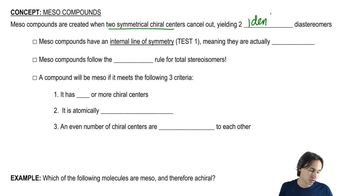
Defining meso compounds.

Types of Carbonyl Compounds

Carbonyl compounds can be classified into aldehydes and ketones, which differ in their structure and reactivity. Aldehydes have at least one hydrogen atom attached to the carbonyl carbon, while ketones have two carbon groups. Identifying the correct type of carbonyl compound is essential for determining the appropriate reduction method to synthesize the desired alcohol.
Video consigliato:
01:40
Defining meso compounds.

Stereochemistry of Alcohols

Stereochemistry refers to the spatial arrangement of atoms in molecules and is particularly important in organic synthesis. Alcohols can exist as chiral molecules, leading to different enantiomers. When synthesizing an alcohol from a carbonyl compound, it is important to consider the stereochemical outcome, as it can affect the properties and reactivity of the final product.
Video consigliato:
Percorso guidato
1:38
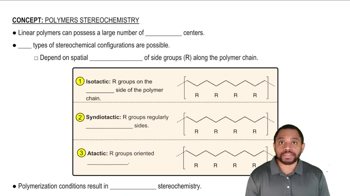
Polymer Stereochemistry Concept 1