Ch.10 - Structure and Synthesis of Alcohols
Wade - Organic Chemistry 9th Edition
Wade9th EditionOrganic ChemistryISBN: 9780135213728Non è quello che usi tu?Cambia libro di testo
Capitolo 10, Problema 26c

Show how you would synthesize the following alcohol by reducing appropriate carbonyl compound.
c. 2-methylhexan-3-ol

Guida verificata passo dopo passo
1
Identify the target alcohol: The compound 2-methylhexan-3-ol is a secondary alcohol, meaning the hydroxyl group (-OH) is attached to a carbon atom that is bonded to two other carbon atoms. This suggests that the precursor is likely a ketone.
Determine the corresponding carbonyl compound: To synthesize 2-methylhexan-3-ol, the corresponding carbonyl compound would be 2-methylhexan-3-one. This is because reducing a ketone with a reducing agent will yield a secondary alcohol.
Choose an appropriate reducing agent: Common reducing agents for converting ketones to secondary alcohols include sodium borohydride (NaBH₄) or lithium aluminum hydride (LiAlH₄). NaBH₄ is often preferred for mild conditions.
Write the reaction mechanism: The reduction involves the nucleophilic attack of the hydride ion (H⁻) from the reducing agent on the carbonyl carbon of 2-methylhexan-3-one. This forms an alkoxide intermediate, which is then protonated by water or an acid to yield 2-methylhexan-3-ol.
Summarize the synthesis: Start with 2-methylhexan-3-one as the carbonyl compound. Treat it with NaBH₄ in a suitable solvent (e.g., ethanol or methanol) to reduce the ketone to 2-methylhexan-3-ol. Finally, perform a workup step to isolate the alcohol product.

Risposta video verificata per un problema simile:

Questa soluzione video è stata consigliata dai nostri tutor come utile per risolvere questo problema.
Durata del video:
3m

Concetti chiave

Ecco i concetti essenziali che devi comprendere per rispondere correttamente alla domanda.

Reduction of Carbonyl Compounds

Reduction is a chemical reaction that involves the gain of electrons or a decrease in oxidation state. In organic chemistry, carbonyl compounds, such as aldehydes and ketones, can be reduced to alcohols using reducing agents like lithium aluminum hydride (LiAlH4) or sodium borohydride (NaBH4). Understanding the mechanism of this reduction is crucial for synthesizing alcohols from carbonyl precursors.
Video consigliato:
01:40
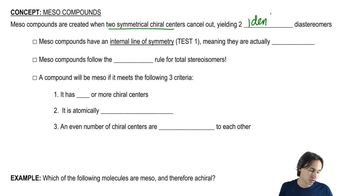
Defining meso compounds.

Structure of 2-methylhexan-3-ol

2-methylhexan-3-ol is a secondary alcohol with a specific carbon skeleton. It consists of a six-carbon chain (hexane) with a methyl group (–CH3) attached to the second carbon and a hydroxyl group (–OH) on the third carbon. Recognizing the structure helps in identifying the appropriate carbonyl compound to reduce in order to achieve the desired alcohol.
Video consigliato:
03:04
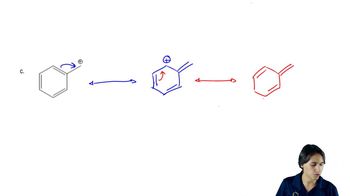
Drawing Resonance Structures

Choice of Carbonyl Compound

To synthesize 2-methylhexan-3-ol, one must select the correct carbonyl compound to reduce. The appropriate precursor is 2-methylhexan-3-one, a ketone, which upon reduction will yield the target alcohol. Understanding the relationship between the structure of the desired alcohol and its corresponding carbonyl compound is essential for successful synthesis.
Video consigliato:
01:40
Defining meso compounds.