
Ch.10 - Structure and Synthesis of Alcohols
Wade - Organic Chemistry 9th Edition
Wade9th EditionOrganic ChemistryISBN: 9780135213728Non è quello che usi tu?Cambia libro di testo
Capitolo 10, Problema 38a

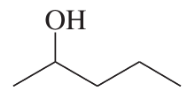
Show how you would synthesize the following alcohol from appropriate alkene.
(a)

Guida verificata passo dopo passo
1
Identify the target alcohol: The structure provided is 2-butanol, which has a hydroxyl (-OH) group attached to the second carbon of a butane chain.
Determine the appropriate alkene precursor: To synthesize 2-butanol, the corresponding alkene would be 2-butene, as the hydroxyl group will be added to the second carbon during the reaction.
Choose the reaction mechanism: The synthesis of an alcohol from an alkene can be achieved through hydration. Specifically, acid-catalyzed hydration or oxymercuration-demercuration can be used to add water (H₂O) across the double bond of the alkene.
Explain regioselectivity: In this case, Markovnikov's rule applies, meaning the hydroxyl group will attach to the more substituted carbon (the second carbon in 2-butene) during the reaction.
Outline the procedure: For acid-catalyzed hydration, treat 2-butene with dilute sulfuric acid (H₂SO₄) and water. Alternatively, for oxymercuration-demercuration, react 2-butene with mercuric acetate (Hg(OAc)₂) in water, followed by reduction with sodium borohydride (NaBH₄). Both methods will yield 2-butanol.

Risposta video verificata per un problema simile:

Questa soluzione video è stata consigliata dai nostri tutor come utile per risolvere questo problema.
Durata del video:
7m

Concetti chiave

Ecco i concetti essenziali che devi comprendere per rispondere correttamente alla domanda.

Alkene Reactivity

Alkenes are unsaturated hydrocarbons characterized by at least one carbon-carbon double bond. Their reactivity is primarily due to this double bond, which can undergo various reactions such as electrophilic addition. Understanding how alkenes react is crucial for synthesizing alcohols, as the addition of water (hydration) to an alkene can yield an alcohol.
Video consigliato:
Percorso guidato
2:09
Alkene Metathesis Concept 1

Hydration Reaction

Hydration is a chemical reaction where water is added to a compound. In organic chemistry, the hydration of alkenes typically involves the addition of water across the double bond, often in the presence of an acid catalyst. This process converts the alkene into an alcohol, making it essential for synthesizing alcohols from alkenes.
Video consigliato:
09:11
Alkyne Hydration

Markovnikov's Rule

Markovnikov's Rule states that when HX (where X is a halogen or OH) is added to an asymmetric alkene, the hydrogen atom will attach to the carbon with the greater number of hydrogen atoms already attached. This principle is important in predicting the outcome of hydration reactions, as it helps determine the structure of the resulting alcohol based on the alkene's substitution pattern.
Video consigliato:
03:54
The 18 and 16 Electron Rule