
Ch.10 - Structure and Synthesis of Alcohols
Wade - Organic Chemistry 9th Edition
Wade9th EditionOrganic ChemistryISBN: 9780135213728Non è quello che usi tu?Cambia libro di testo
Capitolo 10, Problema 37d

Starting from bromobenzene and any other reagents and solvents you need, show how you would synthesize the following compounds. Any of these products may be used as starting materials in subsequent parts of this problem.
d. 3-phenylprop-2-en-1-ol

Guida verificata passo dopo passo
1
Step 1: Begin with bromobenzene as the starting material. Perform a Friedel-Crafts alkylation reaction using propene (CH3-CH=CH2) and a Lewis acid catalyst such as AlCl3. This will introduce a propyl group onto the benzene ring, forming propylbenzene.
Step 2: Oxidize the propyl group on the benzene ring to a propenyl group (CH2=CH-CH2-) using a dehydrohalogenation reaction. This can be achieved by first brominating the benzylic position with NBS (N-Bromosuccinimide) in the presence of light or a radical initiator, followed by elimination using a strong base like KOH or NaOH.
Step 3: Perform a hydroboration-oxidation reaction to convert the terminal alkene group (CH2=CH-) into a primary alcohol (-CH2OH). Use BH3·THF for hydroboration, followed by oxidation with H2O2 and NaOH.
Step 4: Verify the structure of the product, 3-phenylprop-2-en-1-ol, which should now have a benzene ring attached to a three-carbon chain with a double bond between the second and third carbons and a hydroxyl group (-OH) on the first carbon.
Step 5: If needed, purify the product using techniques such as distillation or recrystallization, and confirm its identity using spectroscopic methods like NMR or IR to ensure the correct functional groups are present.

Risposta video verificata per un problema simile:

Questa soluzione video è stata consigliata dai nostri tutor come utile per risolvere questo problema.
Durata del video:
5m

Concetti chiave

Ecco i concetti essenziali che devi comprendere per rispondere correttamente alla domanda.

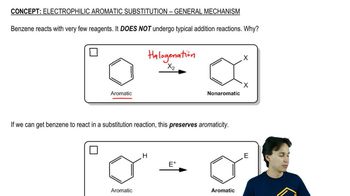
Electrophilic Aromatic Substitution

Electrophilic aromatic substitution (EAS) is a fundamental reaction in organic chemistry where an electrophile replaces a hydrogen atom on an aromatic ring. In the case of bromobenzene, the bromine atom can be replaced by various electrophiles, allowing for the introduction of different functional groups. Understanding EAS is crucial for manipulating aromatic compounds to synthesize desired products.
Video consigliato:
03:07
EAS Review

Allylic Rearrangement

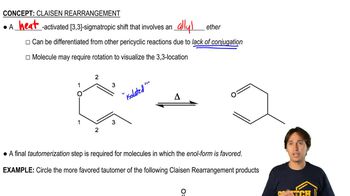
Allylic rearrangement refers to the migration of a substituent in an allylic position, which can lead to the formation of new double bonds or functional groups. This concept is important when synthesizing compounds like 3-phenylprop-2-en-1-ol, as it allows for the transformation of intermediates into the desired product through the rearrangement of carbon skeletons.
Video consigliato:
06:08
Definition of Claisen Rearrangement

Reagents and Solvents in Organic Synthesis

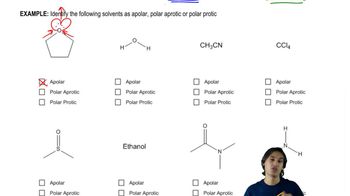
The choice of reagents and solvents is critical in organic synthesis, as they can influence reaction rates, yields, and selectivity. For synthesizing 3-phenylprop-2-en-1-ol, specific reagents such as bases or catalysts may be required to facilitate reactions like dehydrohalogenation or hydration. Understanding the role of these components is essential for successful synthesis.
Video consigliato:
01:16
Identification of polarity in solvents