Ch.10 - Structure and Synthesis of Alcohols
Wade - Organic Chemistry 9th Edition
Wade9th EditionOrganic ChemistryISBN: 9780135213728Non è quello che usi tu?Cambia libro di testo
Capitolo 10, Problema 21d

Show how you would synthesize the following compound from alkyl halides, vinyl halides, and aryl halides containing no more than six carbon atoms.
(d) cyclopentyl propyl ketone

Guida verificata passo dopo passo
1
Step 1: Begin by identifying the target molecule, cyclopentyl propyl ketone. It consists of a cyclopentyl group attached to a propyl ketone functional group. The synthesis will require forming a carbon-carbon bond between the cyclopentyl group and the propyl ketone.
Step 2: Select an appropriate alkyl halide to introduce the cyclopentyl group. Cyclopentyl bromide (C₅H₉Br) is a suitable choice as it contains the cyclopentyl ring and can act as a nucleophile precursor.
Step 3: Choose a propyl halide to form the propyl ketone. Propyl bromide (C₃H₇Br) can be used as a starting material. Convert it into a propyl ketone by reacting it with a carbonyl compound, such as acetyl chloride (CH₃COCl), under Friedel-Crafts acylation conditions.
Step 4: Perform a coupling reaction to connect the cyclopentyl group to the propyl ketone. Use a Grignard reagent, such as cyclopentyl magnesium bromide (C₅H₉MgBr), prepared from cyclopentyl bromide and magnesium in dry ether. React the Grignard reagent with the propyl ketone to form the desired cyclopentyl propyl ketone.
Step 5: Purify the product using standard organic chemistry techniques, such as distillation or recrystallization, to isolate cyclopentyl propyl ketone in its pure form.

Risposta video verificata per un problema simile:

Questa soluzione video è stata consigliata dai nostri tutor come utile per risolvere questo problema.
Durata del video:
3m

Concetti chiave

Ecco i concetti essenziali che devi comprendere per rispondere correttamente alla domanda.

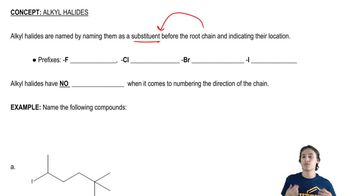
Alkyl Halides

Alkyl halides are organic compounds containing a carbon atom bonded to a halogen atom (such as chlorine, bromine, or iodine). They serve as versatile intermediates in organic synthesis, allowing for the formation of various functional groups through nucleophilic substitution or elimination reactions. Understanding their reactivity is crucial for designing synthetic pathways.
Video consigliato:
01:52
How to name alkyl halides

Grignard Reagents

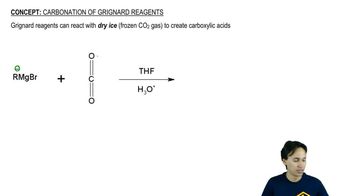
Grignard reagents are organomagnesium compounds formed by reacting alkyl or aryl halides with magnesium metal. They are powerful nucleophiles that can react with carbonyl compounds to form alcohols. In the synthesis of cyclopentyl propyl ketone, Grignard reagents can be used to introduce the cyclopentyl group onto a suitable carbonyl precursor.
Video consigliato:
02:12
Carbonation of Grignard Reagents

Carbonyl Chemistry

Carbonyl chemistry involves the study of compounds containing a carbonyl group (C=O), such as ketones and aldehydes. The reactivity of carbonyl compounds is central to many synthetic strategies, including nucleophilic addition and condensation reactions. In synthesizing cyclopentyl propyl ketone, understanding how to manipulate carbonyl compounds is essential for achieving the desired structure.
Video consigliato:
04:20
Carboxylic Acids Nomenclature