Ch.10 - Structure and Synthesis of Alcohols
Wade - Organic Chemistry 9th Edition
Wade9th EditionOrganic ChemistryISBN: 9780135213728Non è quello che usi tu?Cambia libro di testo
Capitolo 10, Problema 21c

Show how you would synthesize the following compound from alkyl halides, vinyl halides, and aryl halides containing no more than six carbon atoms.
(c) trans-oct-3-ene

Guida verificata passo dopo passo
1
Step 1: Identify the target molecule, trans-oct-3-ene. This is an alkene with a trans configuration, meaning the two substituents on the double bond are on opposite sides. The double bond is located between carbons 3 and 4 in an 8-carbon chain.
Step 2: Plan the retrosynthesis. Break the molecule into smaller components that can be synthesized from the allowed starting materials (alkyl halides, vinyl halides, and aryl halides with no more than six carbons). A logical disconnection is at the double bond, suggesting a coupling reaction such as the Wittig reaction or a cross-coupling reaction like the Heck reaction.
Step 3: Choose a suitable reaction. For this synthesis, the Heck reaction is a good choice. The Heck reaction involves the coupling of a vinyl halide with an alkyl halide in the presence of a palladium catalyst to form a substituted alkene. Ensure that the starting materials are trans-configured to maintain the stereochemistry of the product.
Step 4: Select the starting materials. Use a vinyl halide such as 1-bromo-1-hexene (C6H11Br) and an alkyl halide such as ethyl bromide (C2H5Br). These compounds meet the requirement of having no more than six carbons.
Step 5: Perform the Heck reaction. Combine the vinyl halide and alkyl halide in the presence of a palladium catalyst (e.g., Pd(PPh3)4) and a base (e.g., triethylamine) under appropriate reaction conditions. This will yield trans-oct-3-ene as the product.

Risposta video verificata per un problema simile:

Questa soluzione video è stata consigliata dai nostri tutor come utile per risolvere questo problema.
Durata del video:
6m

Concetti chiave

Ecco i concetti essenziali che devi comprendere per rispondere correttamente alla domanda.

Alkyl Halides

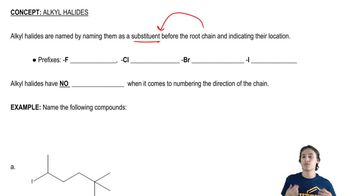
Alkyl halides are organic compounds derived from alkanes that contain one or more halogen atoms (F, Cl, Br, I) attached to a carbon atom. They are key intermediates in organic synthesis, often undergoing nucleophilic substitution or elimination reactions to form alkenes or other functional groups. Understanding their reactivity is essential for synthesizing compounds like trans-oct-3-ene.
Video consigliato:
01:52
How to name alkyl halides

Elimination Reactions

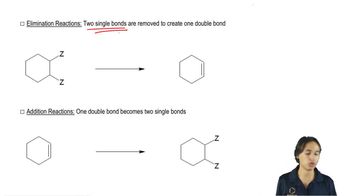
Elimination reactions involve the removal of a small molecule (often HX) from a larger molecule, resulting in the formation of a double bond. In the context of synthesizing alkenes, such as trans-oct-3-ene, elimination can be achieved through dehydrohalogenation of alkyl halides. The stereochemistry of the elimination reaction is crucial for obtaining the desired trans isomer.
Video consigliato:
00:40
Recognizing Elimination Reactions.

Stereochemistry

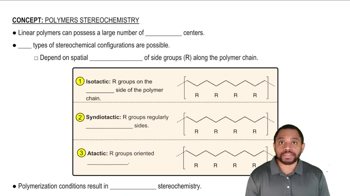
Stereochemistry refers to the spatial arrangement of atoms in molecules and how this affects their chemical properties and reactions. For trans-oct-3-ene, the specific arrangement of substituents around the double bond is important for its identity and reactivity. Understanding stereochemical principles helps in predicting the outcomes of reactions and ensuring the correct isomer is synthesized.
Video consigliato:
Percorso guidato
1:38
Polymer Stereochemistry Concept 1