
Ch.10 - Structure and Synthesis of Alcohols
Wade - Organic Chemistry 9th Edition
Wade9th EditionOrganic ChemistryISBN: 9780135213728Non è quello che usi tu?Cambia libro di testo
Capitolo 10, Problema 37b

Starting from bromobenzene and any other reagents and solvents you need, show how you would synthesize the following compounds. Any of these products may be used as starting materials in subsequent parts of this problem.
b. 1-phenylpropene

Guida verificata passo dopo passo
1
Step 1: Begin with bromobenzene (C₆H₅Br) as the starting material. Perform a Grignard reaction by reacting bromobenzene with magnesium (Mg) in anhydrous ether to form phenylmagnesium bromide (C₆H₅MgBr). This step generates the Grignard reagent.
Step 2: Prepare propanal (CH₃CH₂CHO) as the electrophile. Propanal can be obtained from commercially available sources or synthesized if necessary.
Step 3: React the phenylmagnesium bromide (C₆H₅MgBr) with propanal (CH₃CH₂CHO) in an anhydrous ether solvent. This reaction will result in the formation of a secondary alcohol, 1-phenyl-2-propanol (C₆H₅CH(OH)CH₂CH₃), after hydrolysis with dilute acid.
Step 4: Dehydrate the secondary alcohol (1-phenyl-2-propanol) to form 1-phenylpropene (C₆H₅CH=CHCH₃). Use an acid catalyst such as concentrated sulfuric acid (H₂SO₄) or phosphoric acid (H₃PO₄) to promote the elimination reaction.
Step 5: Purify the product, 1-phenylpropene, using distillation or another appropriate purification technique to isolate the desired compound.

Risposta video verificata per un problema simile:

Questa soluzione video è stata consigliata dai nostri tutor come utile per risolvere questo problema.
Durata del video:
9m

Concetti chiave

Ecco i concetti essenziali che devi comprendere per rispondere correttamente alla domanda.

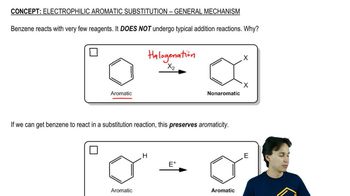
Electrophilic Aromatic Substitution

Electrophilic aromatic substitution (EAS) is a fundamental reaction in organic chemistry where an electrophile replaces a hydrogen atom on an aromatic ring. In the case of bromobenzene, the bromine atom can be replaced by other substituents through EAS, allowing for the introduction of functional groups that can further react to form desired products like 1-phenylpropene.
Video consigliato:
03:07
EAS Review

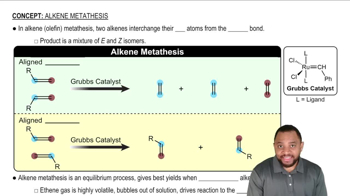
Alkene Formation

Alkene formation is a key reaction in organic synthesis, often achieved through elimination reactions. In synthesizing 1-phenylpropene, a common method involves the dehydrohalogenation of an alkyl halide, which can be derived from bromobenzene through a series of reactions, ultimately leading to the formation of a double bond between the phenyl group and the propene chain.
Video consigliato:
Percorso guidato
2:09
Alkene Metathesis Concept 1

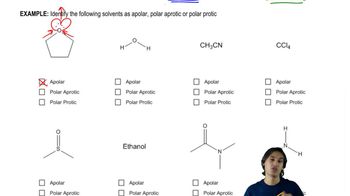
Reagents and Solvents in Organic Synthesis

The choice of reagents and solvents is crucial in organic synthesis as they influence the reaction pathway, yield, and selectivity. For synthesizing 1-phenylpropene from bromobenzene, reagents such as strong bases (e.g., KOH) for elimination and solvents like ethanol or DMF may be used to facilitate the reaction conditions necessary for the desired transformations.
Video consigliato:
01:16
Identification of polarity in solvents