Ch.11 - Reactions of Alcohols
Wade - Organic Chemistry 9th Edition
Wade9th EditionOrganic ChemistryISBN: 9780135213728Non è quello che usi tu?Cambia libro di testo
Capitolo 11, Problema 5d,e

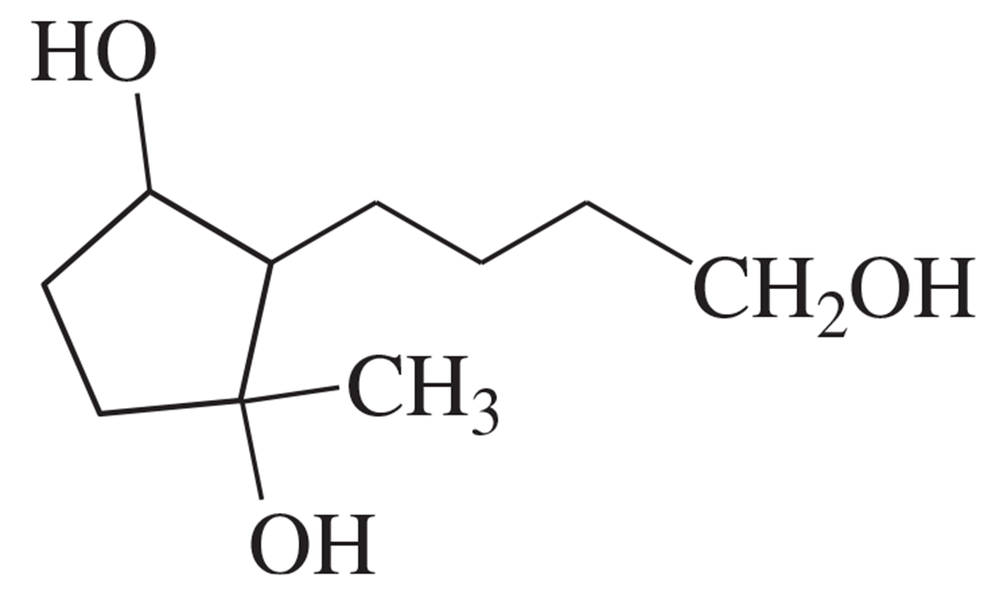
Predict the products you expect when the following starting material undergoes oxidation with an excess of each of the reagents shown below.

d. DMSO and oxalyl chloride
e. DMP (periodinane) reagent

Guida verificata passo dopo passo
1
Analyze the structure of the starting material: The molecule contains two primary alcohol groups (-CH2OH) and one secondary alcohol group (-CHOH). These functional groups are susceptible to oxidation under the given conditions.
Understand the role of DMSO and oxalyl chloride (Swern oxidation): This reagent combination selectively oxidizes primary alcohols to aldehydes and secondary alcohols to ketones without over-oxidizing to carboxylic acids.
Predict the product for DMSO and oxalyl chloride: The primary alcohol group (-CH2OH) on the side chain will be oxidized to an aldehyde (-CHO), and the secondary alcohol group (-CHOH) in the ring will be oxidized to a ketone (-C=O). The hydroxyl group (-OH) on the ring that is not part of an alcohol functional group will remain unchanged.
Understand the role of DMP (Dess-Martin periodinane): DMP is a mild oxidizing agent that also selectively oxidizes primary alcohols to aldehydes and secondary alcohols to ketones, similar to Swern oxidation.
Predict the product for DMP: The primary alcohol group (-CH2OH) on the side chain will be oxidized to an aldehyde (-CHO), and the secondary alcohol group (-CHOH) in the ring will be oxidized to a ketone (-C=O). The hydroxyl group (-OH) on the ring that is not part of an alcohol functional group will remain unchanged.

Risposta video verificata per un problema simile:

Questa soluzione video è stata consigliata dai nostri tutor come utile per risolvere questo problema.
Durata del video:
2m

Concetti chiave

Ecco i concetti essenziali che devi comprendere per rispondere correttamente alla domanda.

Oxidation Reactions

Oxidation reactions involve the loss of electrons or an increase in oxidation state by a molecule. In organic chemistry, this often pertains to the conversion of alcohols to carbonyl compounds or further to carboxylic acids. Understanding the specific reagents used in oxidation, such as DMSO and periodinane, is crucial for predicting the products formed.
Video consigliato:
03:20
Benzylic Oxidation

DMSO and Oxalyl Chloride

DMSO (dimethyl sulfoxide) in combination with oxalyl chloride is a powerful oxidizing system that can convert alcohols to aldehydes or ketones. This reagent pair is particularly effective for transforming primary alcohols into aldehydes without over-oxidation to carboxylic acids, making it essential to recognize the expected product based on the starting material.
Video consigliato:
03:13
Acid Chloride Nomenclature

DMP (Dess-Martin Periodinane)

DMP, or Dess-Martin periodinane, is a mild and selective oxidizing agent used primarily for the oxidation of alcohols to aldehydes and ketones. It is favored for its ability to perform these transformations under mild conditions, minimizing side reactions. Understanding its selectivity helps in predicting the outcome of oxidation reactions involving various alcohols.
Pratica correlata
Domanda del libro di testo

Give the structure of the principal product(s) when each of the following alcohols reacts with (1) Na2Cr2O7/H2SO4, (2) PCC

d. 1-methylcyclohexan-1,4-diol

648
views

Domanda del libro di testo

Suggest the most appropriate method for each of the following laboratory syntheses. In each case, suggest both a chromium reagent and a chromium-free reagent.

(a) butan-1-ol → butanal, CH3CH2CH2CHO

(b) but-2-en-1-ol → but-2-enoic acid, CH3CH=CH–COOH

(c) butan-2-ol → butan-2-one, CH3COCH2CH3

1376
views
Domanda del libro di testo

Suggest the most appropriate method for each of the following laboratory syntheses. In each case, suggest both a chromium reagent and a chromium-free reagent.

(f) 1-methylcyclohexanol → 2-methylcyclohexanone (several steps)

891
views
Domanda del libro di testo

Predict the products you expect when the following starting material undergoes oxidation with an excess of each of the reagents shown below.

a. chromic acid

b. PCC (pyridinium chlorochromate)

c. sodium hypochlorite/acetic acid

1323
views
Domanda del libro di testo

Suggest the most appropriate method for each of the following laboratory syntheses. In each case, suggest both a chromium reagent and a chromium-free reagent.

(d) cyclopentanol → 1-ethylcyclopentanol (two steps)

(e) cyclopentylmethanol → 1-cyclopentylpropan-1-ol (two steps)

896
views
Domanda del libro di testo

Give the structure of the principal product(s) when each of the following alcohols reacts with (1) Na2Cr2O7/H2SO4, (2) PCC

c. 4-hydroxydecanal

815
views