
Ch.11 - Reactions of Alcohols
Wade - Organic Chemistry 9th Edition
Wade9th EditionOrganic ChemistryISBN: 9780135213728Non è quello che usi tu?Cambia libro di testo
Capitolo 11, Problema 6f

Suggest the most appropriate method for each of the following laboratory syntheses. In each case, suggest both a chromium reagent and a chromium-free reagent.
(f) 1-methylcyclohexanol → 2-methylcyclohexanone (several steps)

Guida verificata passo dopo passo
1
Step 1: Recognize the transformation. The problem involves converting 1-methylcyclohexanol (a secondary alcohol) into 2-methylcyclohexanone (a ketone). This requires oxidation and a shift of the methyl group from position 1 to position 2.
Step 2: Plan the oxidation step. To oxidize the secondary alcohol to a ketone, you can use a chromium-based reagent such as pyridinium chlorochromate (PCC) or Jones reagent (CrO₃ in H₂SO₄). Alternatively, for a chromium-free option, you can use Dess-Martin periodinane (DMP) or Swern oxidation.
Step 3: Consider the methyl group migration. After oxidation, you need to shift the methyl group from position 1 to position 2. This can be achieved through a rearrangement reaction, such as a pinacol rearrangement, which involves acidic conditions to promote the migration.
Step 4: Suggest the chromium-based method. Use PCC or Jones reagent to oxidize 1-methylcyclohexanol to 1-methylcyclohexanone. Then, treat the ketone with an acid catalyst (e.g., H₂SO₄) to induce the methyl group migration, forming 2-methylcyclohexanone.
Step 5: Suggest the chromium-free method. Use Dess-Martin periodinane (DMP) or Swern oxidation to oxidize 1-methylcyclohexanol to 1-methylcyclohexanone. Follow this with the same acid-catalyzed rearrangement to achieve the desired product, 2-methylcyclohexanone.

Risposta video verificata per un problema simile:

Questa soluzione video è stata consigliata dai nostri tutor come utile per risolvere questo problema.
Durata del video:
7m

Concetti chiave

Ecco i concetti essenziali che devi comprendere per rispondere correttamente alla domanda.

Oxidation Reactions

Oxidation reactions involve the loss of electrons or an increase in oxidation state by a molecule. In organic chemistry, these reactions are crucial for converting alcohols into carbonyl compounds, such as ketones. Understanding the mechanisms of oxidation helps in selecting appropriate reagents for synthesizing compounds like 2-methylcyclohexanone from 1-methylcyclohexanol.
Video consigliato:
03:20
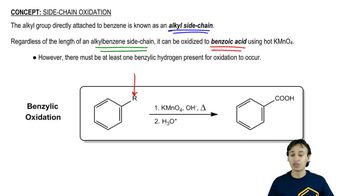
Benzylic Oxidation

Chromium Reagents

Chromium reagents, such as chromium trioxide (CrO3) or pyridinium chlorochromate (PCC), are commonly used in organic synthesis for the oxidation of alcohols to carbonyl compounds. These reagents are effective but can be toxic and environmentally hazardous, necessitating careful handling and disposal. Knowledge of their reactivity and selectivity is essential for proposing suitable methods in laboratory syntheses.
Video consigliato:
06:50
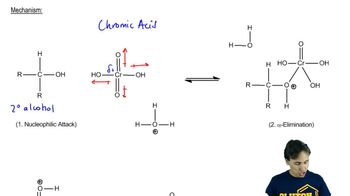
Jones Reagent Mechanism

Alternative Oxidation Methods

Chromium-free oxidation methods, such as using Dess-Martin periodinane or Swern oxidation, provide safer and more environmentally friendly alternatives for converting alcohols to ketones. These methods often have milder reaction conditions and fewer toxic byproducts, making them attractive options in organic synthesis. Familiarity with these alternatives is important for suggesting diverse synthetic pathways.
Video consigliato:
Percorso guidato
1:24
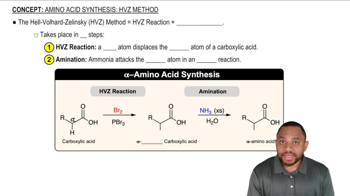
Amino Acid Synthesis: HVZ Method Concept 1
Pratica correlata
Domanda del libro di testo

A chronic alcoholic requires a much larger dose of ethanol as an antidote to methanol poisoning than does a nonalcoholic patient. Suggest a reason why a larger dose of the competitive inhibitor is required for an alcoholic.

935
views
Domanda del libro di testo

Suggest the most appropriate method for each of the following laboratory syntheses. In each case, suggest both a chromium reagent and a chromium-free reagent.

(a) butan-1-ol → butanal, CH3CH2CH2CHO

(b) but-2-en-1-ol → but-2-enoic acid, CH3CH=CH–COOH

(c) butan-2-ol → butan-2-one, CH3COCH2CH3

1376
views
Domanda del libro di testo

Predict the major products of the following reactions.

(d) the tosylate of cyclohexylmethanol + excess NH3

(e) n-butyl tosylate + sodium acetylide, H–C≡C:– +Na

1360
views
Domanda del libro di testo

Suggest the most appropriate method for each of the following laboratory syntheses. In each case, suggest both a chromium reagent and a chromium-free reagent.

(d) cyclopentanol → 1-ethylcyclopentanol (two steps)

(e) cyclopentylmethanol → 1-cyclopentylpropan-1-ol (two steps)

896
views
Domanda del libro di testo

Predict the major products of the following reactions.

(a) ethyl tosylate + potassium tert-butoxide

(b) isobutyl tosylate + NaI

(c) (R)-2-hexyl tosylate + NaCN

2426
views
Domanda del libro di testo

Predict the products you expect when the following starting material undergoes oxidation with an excess of each of the reagents shown below.

d. DMSO and oxalyl chloride

e. DMP (periodinane) reagent

712
views