Ch.11 - Reactions of Alcohols
Wade - Organic Chemistry 9th Edition
Wade9th EditionOrganic ChemistryISBN: 9780135213728Non è quello che usi tu?Cambia libro di testo
Capitolo 11, Problema 55b

Propose mechanisms for the following reactions. In most cases, more products are formed than are shown here. You only need to explain the formation of the products shown, however.
(b) Chemical reaction diagram showing dehydration of an alcohol to form alkenes, with reactants and products labeled.

Guida verificata passo dopo passo
1
Step 1: Analyze the starting material and reaction conditions. The starting material is an alcohol with a double bond in a cyclohexane ring. The reaction conditions include H2SO4 (sulfuric acid) and heat, which suggest an acid-catalyzed dehydration reaction to form alkenes.
Step 2: Protonation of the alcohol group. The hydroxyl group (-OH) is protonated by H2SO4, converting it into a better leaving group (water). This step increases the electrophilicity of the carbon attached to the hydroxyl group.
Step 3: Formation of a carbocation intermediate. After the departure of water, a carbocation is formed at the carbon where the hydroxyl group was attached. The stability of the carbocation is enhanced by resonance with the double bond in the cyclohexane ring.
Step 4: Rearrangement of the carbocation. A hydride shift or alkyl shift may occur to form a more stable carbocation. In this case, the carbocation rearranges to form a bicyclic structure, which is stabilized by conjugation with the double bond.
Step 5: Elimination to form the products. A proton is removed from a neighboring carbon by the conjugate base (HSO4-), leading to the formation of the double bonds in the final products. Two different alkenes are formed due to the possibility of elimination occurring at different positions, resulting in the two products shown.

Risposta video verificata per un problema simile:

Questa soluzione video è stata consigliata dai nostri tutor come utile per risolvere questo problema.
Durata del video:
4m

Concetti chiave

Ecco i concetti essenziali che devi comprendere per rispondere correttamente alla domanda.

Reaction Mechanisms

A reaction mechanism is a step-by-step description of how reactants transform into products during a chemical reaction. It outlines the sequence of elementary steps, including bond breaking and formation, and provides insight into the intermediates and transition states involved. Understanding mechanisms is crucial for predicting the products of reactions and for grasping the underlying principles of organic chemistry.
Video consigliato:
02:16
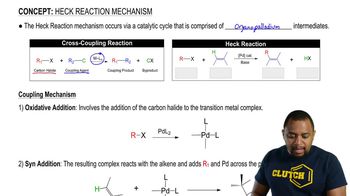
Heck Reaction Mechanism

Types of Organic Reactions

Organic reactions can be classified into several types, including substitution, addition, elimination, and rearrangement reactions. Each type has distinct characteristics and mechanisms. Recognizing the type of reaction helps in predicting the behavior of reactants and the nature of the products formed, which is essential for proposing accurate mechanisms.
Video consigliato:
07:37
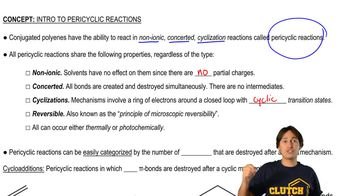
Properties and Types of Pericyclic Reactions

Intermediates and Transition States

Intermediates are transient species formed during the course of a reaction, while transition states represent the highest energy state along the reaction pathway. Both play a critical role in understanding reaction mechanisms, as they influence the rate and outcome of the reaction. Identifying these species helps in elucidating how reactants convert to products and in predicting the stability and reactivity of different compounds.
Video consigliato:
06:55
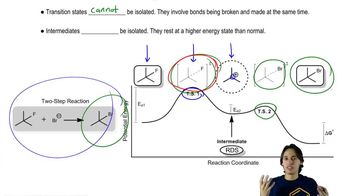
Intermediates vs. Transition States