

Ch.11 - Reactions of Alcohols
Wade - Organic Chemistry 9th Edition
Wade9th EditionOrganic ChemistryISBN: 9780135213728Non è quello che usi tu?Cambia libro di testo
Capitolo 11, Problema 10a,b

Show how you would convert propan-1-ol to the following compounds using tosylate intermediates. You may use whatever additional reagents are needed.
a. 1-bromopropane
b. propan-1-amine, CH3CH2CH2NH2

Guida verificata passo dopo passo
1
Step 1: Begin by converting propan-1-ol (CH3CH2CH2OH) into its tosylate intermediate. This is achieved by reacting propan-1-ol with p-toluenesulfonyl chloride (TsCl) in the presence of a base such as pyridine. The hydroxyl group (-OH) is replaced with a tosyl group (-OTs), forming propyl tosylate (CH3CH2CH2OTs).
Step 2: For part (a), to convert propyl tosylate into 1-bromopropane (CH3CH2CH2Br), perform a nucleophilic substitution reaction. React propyl tosylate with sodium bromide (NaBr) in a polar aprotic solvent like acetone. The tosyl group (-OTs) is replaced by a bromide ion (Br⁻) via an SN2 mechanism.
Step 3: For part (b), to convert propyl tosylate into propan-1-amine (CH3CH2CH2NH2), perform another nucleophilic substitution reaction. React propyl tosylate with excess ammonia (NH3) in a suitable solvent. The tosyl group (-OTs) is replaced by an amine group (-NH2) via an SN2 mechanism.
Step 4: Ensure proper reaction conditions for both conversions. For the SN2 reactions, use polar aprotic solvents to favor the substitution mechanism and avoid side reactions. Maintain appropriate temperatures to optimize reaction rates.
Step 5: After the reactions, purify the products (1-bromopropane and propan-1-amine) using techniques such as distillation or recrystallization, depending on the physical properties of the compounds. Confirm the identity of the products using spectroscopic methods like NMR or IR.

Risposta video verificata per un problema simile:

Questa soluzione video è stata consigliata dai nostri tutor come utile per risolvere questo problema.
Durata del video:
4m

Concetti chiave

Ecco i concetti essenziali che devi comprendere per rispondere correttamente alla domanda.

Tosylate Formation

Tosylates are formed by reacting alcohols with tosyl chloride (TsCl) in the presence of a base. This reaction converts the alcohol into a better leaving group, the tosylate, which can facilitate subsequent nucleophilic substitution reactions. The tosylate retains the configuration of the original alcohol, making it a useful intermediate for further transformations.
Video consigliato:
02:26
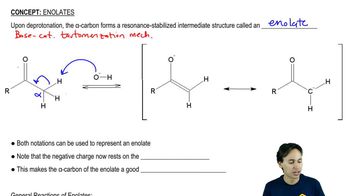
Formation of Enolates

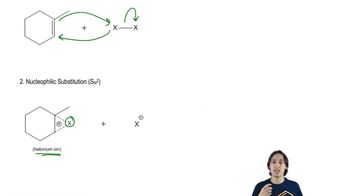
Nucleophilic Substitution Reactions

Nucleophilic substitution reactions involve the replacement of a leaving group in a molecule with a nucleophile. In the case of converting tosylates, the nucleophile attacks the carbon atom bonded to the tosylate, leading to the formation of a new compound. This mechanism can follow either an SN1 or SN2 pathway, depending on the structure of the substrate and the nucleophile used.
Video consigliato:
01:47
Nucleophiles and Electrophiles can react in Substitution Reactions.

Reagents for Halogenation and Amination

To convert a tosylate to a bromo compound, reagents like sodium bromide (NaBr) in a polar aprotic solvent can be used to facilitate the substitution. For amination, a strong nucleophile such as ammonia (NH3) or an amine can be employed to replace the tosylate with an amine group. Understanding the choice of reagents is crucial for achieving the desired product efficiently.
Video consigliato:
03:45
Halogenation Mechanism