Ch.11 - Reactions of Alcohols
Wade - Organic Chemistry 9th Edition
Wade9th EditionOrganic ChemistryISBN: 9780135213728Non è quello che usi tu?Cambia libro di testo
Capitolo 11, Problema 10c,d

Show how you would convert propan-1-ol to the following compounds using tosylate intermediates. You may use whatever additional reagents are needed.
c. CH3CH2CH2OCH2CH3, ethyl proyl ether
d. CH3CH2CH2CN, butyronitrile

Guida verificata passo dopo passo
1
Step 1: Begin with propan-1-ol (CH3CH2CH2OH). Convert the hydroxyl group (-OH) into a good leaving group by reacting it with p-toluenesulfonyl chloride (TsCl) in the presence of a base like pyridine. This forms propyl tosylate (CH3CH2CH2OTs).
Step 2: For part (c), to synthesize ethyl propyl ether (CH3CH2CH2OCH2CH3), perform a Williamson ether synthesis. React the propyl tosylate (CH3CH2CH2OTs) with sodium ethoxide (CH3CH2ONa). The ethoxide ion acts as a nucleophile, displacing the tosyl group and forming the ether bond.
Step 3: For part (d), to synthesize butyronitrile (CH3CH2CH2CN), perform a nucleophilic substitution reaction. React the propyl tosylate (CH3CH2CH2OTs) with sodium cyanide (NaCN). The cyanide ion (CN⁻) acts as a nucleophile, displacing the tosyl group and forming the nitrile group.
Step 4: Ensure proper reaction conditions for each step. For the Williamson ether synthesis, use an aprotic solvent like dimethyl sulfoxide (DMSO) to favor the SN2 mechanism. For the nitrile synthesis, also use an aprotic solvent to enhance the nucleophilicity of CN⁻.
Step 5: After each reaction, purify the product using appropriate techniques such as distillation or recrystallization, and confirm the structure of the final compounds using spectroscopic methods like NMR or IR.

Risposta video verificata per un problema simile:

Questa soluzione video è stata consigliata dai nostri tutor come utile per risolvere questo problema.
Durata del video:
7m

Concetti chiave

Ecco i concetti essenziali che devi comprendere per rispondere correttamente alla domanda.

Tosylate Formation

Tosylates are formed by reacting alcohols with tosyl chloride (TsCl) in the presence of a base, converting the hydroxyl group into a better leaving group. This transformation is crucial for facilitating nucleophilic substitution reactions, as the tosylate can be displaced by various nucleophiles, allowing for the synthesis of more complex molecules.
Video consigliato:
02:26
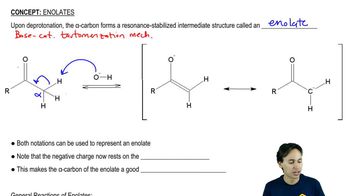
Formation of Enolates

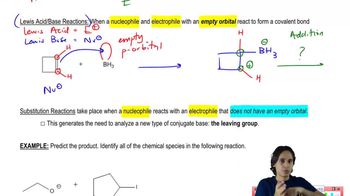
Nucleophilic Substitution Reactions

Nucleophilic substitution reactions involve the replacement of a leaving group in a molecule with a nucleophile. In the context of converting propan-1-ol to ethers or nitriles, the tosylate intermediate serves as a substrate for nucleophiles like alkoxides or cyanide ions, which attack the electrophilic carbon, leading to the desired product.
Video consigliato:
01:47
Nucleophiles and Electrophiles can react in Substitution Reactions.

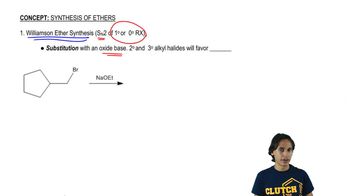
Ether Synthesis

Ether synthesis can be achieved through the reaction of an alkoxide ion with an alkyl halide or tosylate. In this case, the reaction of the tosylate derived from propan-1-ol with an appropriate alkoxide will yield the desired ether, such as CH3CH2CH2OCH2CH3, demonstrating the utility of tosylates in forming ethers efficiently.
Video consigliato:
03:50
The Mechanism of Williamson Ether Synthesis.