Ch.11 - Reactions of Alcohols
Wade - Organic Chemistry 9th Edition
Wade9th EditionOrganic ChemistryISBN: 9780135213728Non è quello che usi tu?Cambia libro di testo
Capitolo 11, Problema 14d,e

Show how you would use a simple chemical test to distinguish between the following pairs of compounds. Tell what you would observe with each compound.
(d) allyl alcohol and propan-1-ol
(e) butan-2-one and tert-butyl alcohol

Guida verificata passo dopo passo
1
Step 1: Understand the functional groups in each compound. Allyl alcohol (CH2=CH-CH2OH) contains a hydroxyl group (-OH) attached to an allylic carbon (a carbon adjacent to a double bond). Propan-1-ol (CH3-CH2-CH2OH) is a primary alcohol with no double bonds. Butan-2-one (CH3-CO-CH2-CH3) is a ketone, while tert-butyl alcohol (C(CH3)3OH) is a tertiary alcohol.
Step 2: For part (d), use the bromine water test. Bromine water (Br2 in water) reacts with compounds containing carbon-carbon double bonds. Allyl alcohol will decolorize bromine water due to the presence of the double bond, while propan-1-ol will not react and the bromine water will remain orange.
Step 3: Observe the results for part (d). Allyl alcohol will cause the orange bromine water to turn colorless, indicating the presence of a double bond. Propan-1-ol will not cause any color change, confirming the absence of a double bond.
Step 4: For part (e), use the iodoform test. The iodoform test detects methyl ketones (compounds with a CH3-CO- group) or secondary alcohols that can be oxidized to methyl ketones. Butan-2-one, being a methyl ketone, will give a positive iodoform test, forming a yellow precipitate of iodoform (CHI3). Tert-butyl alcohol, being a tertiary alcohol, will not react and will give a negative result.
Step 5: Observe the results for part (e). Butan-2-one will produce a yellow precipitate, indicating a positive iodoform test. Tert-butyl alcohol will not produce any precipitate, confirming a negative iodoform test.

Risposta video verificata per un problema simile:

Questa soluzione video è stata consigliata dai nostri tutor come utile per risolvere questo problema.
Durata del video:
5m

Concetti chiave

Ecco i concetti essenziali che devi comprendere per rispondere correttamente alla domanda.

Alcohol Functional Groups

Alcohols are organic compounds characterized by the presence of one or more hydroxyl (-OH) groups. The position of the hydroxyl group can significantly influence the chemical properties and reactivity of the alcohol. For example, allyl alcohol has a double bond adjacent to the hydroxyl group, which can participate in different reactions compared to propan-1-ol, a primary alcohol.
Video consigliato:
02:36
Identifying Functional Groups

Oxidation Reactions

Oxidation reactions involve the loss of electrons or an increase in oxidation state, often resulting in the conversion of alcohols to aldehydes, ketones, or carboxylic acids. In distinguishing between butan-2-one and tert-butyl alcohol, the ability of the alcohol to be oxidized is crucial. Tert-butyl alcohol, being a tertiary alcohol, is resistant to oxidation, while butan-2-one, a ketone, does not undergo oxidation in the same manner.
Video consigliato:
03:20
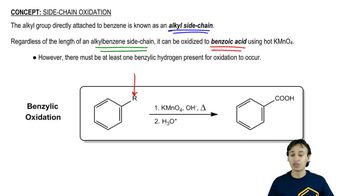
Benzylic Oxidation

Chemical Tests for Functional Groups

Specific chemical tests can be employed to identify functional groups in organic compounds. For instance, the Lucas test can differentiate between primary, secondary, and tertiary alcohols based on their reactivity with hydrochloric acid and zinc chloride. Observations such as the formation of an emulsion or a color change can indicate the presence of certain functional groups, aiding in the distinction between compounds like allyl alcohol and propan-1-ol.
Video consigliato:
02:36
Identifying Functional Groups