

Ch.11 - Reactions of Alcohols
Wade - Organic Chemistry 9th Edition
Wade9th EditionOrganic ChemistryISBN: 9780135213728Non è quello che usi tu?Cambia libro di testo
Capitolo 11, Problema 12a

Propose a mechanism for the reaction of
(a) 1-methylcyclohexanol with HBr to form 1-bromo-1-methylcyclohexane.

Guida verificata passo dopo passo
1
Step 1: Protonation of the alcohol group - The hydroxyl group (-OH) in 1-methylcyclohexanol is a poor leaving group. To make it a better leaving group, it is protonated by HBr, forming water (H2O) as a better leaving group. This step involves the transfer of a proton (H⁺) from HBr to the oxygen atom of the hydroxyl group.
Step 2: Formation of a carbocation intermediate - After protonation, the water molecule leaves, resulting in the formation of a carbocation at the carbon atom that was originally bonded to the hydroxyl group. Since the hydroxyl group is attached to a tertiary carbon (1-methylcyclohexanol is a tertiary alcohol), the resulting carbocation is a tertiary carbocation, which is relatively stable due to hyperconjugation and inductive effects.
Step 3: Nucleophilic attack by bromide ion - The bromide ion (Br⁻), which is generated from the dissociation of HBr, acts as a nucleophile and attacks the positively charged carbocation. This step involves the formation of a new C-Br bond, resulting in the product 1-bromo-1-methylcyclohexane.
Step 4: Verify the stereochemistry - Since the reaction proceeds through a carbocation intermediate, the product may exhibit racemization if the carbon center is chiral. However, in this case, the product is not chiral, so no stereochemical considerations are necessary.
Step 5: Summarize the mechanism - The overall reaction involves three key steps: protonation of the alcohol group, formation of a carbocation intermediate, and nucleophilic attack by the bromide ion. The final product is 1-bromo-1-methylcyclohexane.

Risposta video verificata per un problema simile:

Questa soluzione video è stata consigliata dai nostri tutor come utile per risolvere questo problema.
Durata del video:
6m

Concetti chiave

Ecco i concetti essenziali che devi comprendere per rispondere correttamente alla domanda.

Alcohol Reactivity

Alcohols, such as 1-methylcyclohexanol, can undergo nucleophilic substitution reactions. In the presence of strong acids like HBr, the hydroxyl (-OH) group is protonated, converting it into a better leaving group (water). This transformation is crucial for facilitating the subsequent substitution reaction where the bromide ion replaces the -OH group.
Video consigliato:
01:01
How to name alcohols

Nucleophilic Substitution Mechanism

The reaction mechanism for converting alcohols to alkyl halides typically follows an SN1 or SN2 pathway. In this case, the reaction likely proceeds via an SN1 mechanism due to the stability of the carbocation formed after the leaving group departs. The formation of a stable tertiary or secondary carbocation allows for the rapid attack by the bromide ion, leading to the final product.
Video consigliato:
01:47
Nucleophiles and Electrophiles can react in Substitution Reactions.

Carbocation Stability

Carbocation stability is a key factor in determining the pathway of nucleophilic substitution reactions. Tertiary carbocations are more stable than secondary or primary ones due to hyperconjugation and inductive effects from surrounding alkyl groups. In the case of 1-methylcyclohexanol, the formation of a stable carbocation intermediate is essential for the efficient conversion to 1-bromo-1-methylcyclohexane.
Video consigliato:
05:58
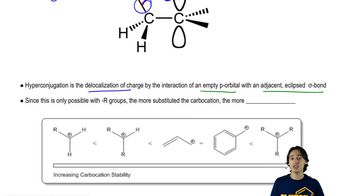
Determining Carbocation Stability