Ch.11 - Reactions of Alcohols
Wade - Organic Chemistry 9th Edition
Wade9th EditionOrganic ChemistryISBN: 9780135213728Non è quello che usi tu?Cambia libro di testo
Capitolo 11, Problema 23

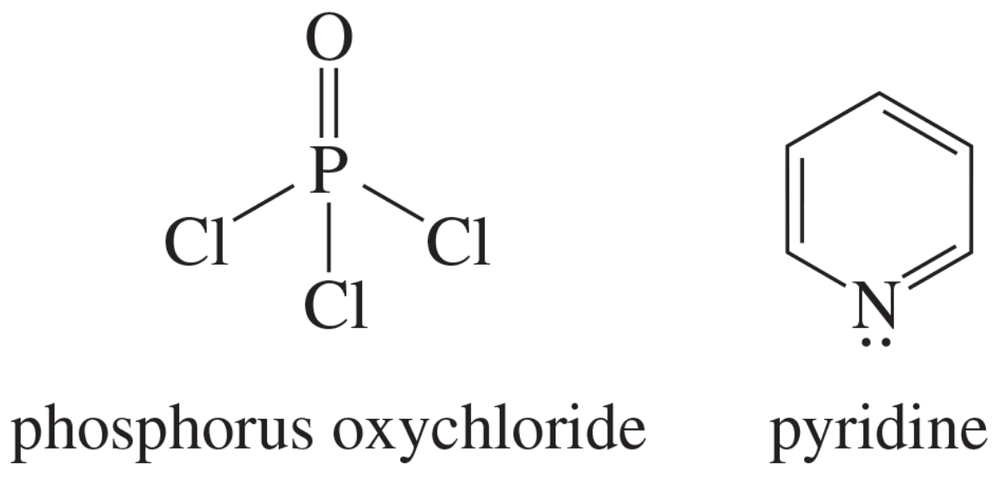
Some alcohols undergo rearrangement or other unwanted side reactions when they dehydrate in acid. Alcohols may be dehydrated under mildly basic conditions using phosphorus oxy-chloride (POCl3) in pyridine. The alcohol reacts with phosphorus oxychloride much like it reacts with tosyl chloride (Section 11-5), displacing a chloride ion from phosphorus to give an alkyl dichlorophosphate ester. The dichlorophosphate group is an outstanding leaving group. Pyridine reacts as a base with the dichlorophosphate ester to give an E2 elimination. Propose a mechanism for the dehydration of cyclohexanol by POCl3 in pyridine.

Guida verificata passo dopo passo
1
Step 1: Activation of cyclohexanol - Cyclohexanol reacts with phosphorus oxychloride (POCl3). The hydroxyl group of cyclohexanol acts as a nucleophile and attacks the phosphorus atom of POCl3, displacing one of the chloride ions. This forms an alkyl dichlorophosphate ester intermediate.
Step 2: Formation of the leaving group - The dichlorophosphate group attached to cyclohexanol is an excellent leaving group. Pyridine, acting as a base, facilitates the next step by abstracting a proton from the cyclohexanol molecule.
Step 3: E2 elimination mechanism - Pyridine abstracts a proton from the β-carbon of the cyclohexanol molecule. Simultaneously, the dichlorophosphate group leaves, resulting in the formation of a double bond between the α and β carbons. This is an E2 elimination reaction.
Step 4: Formation of cyclohexene - The result of the E2 elimination is the formation of cyclohexene, a dehydrated product of cyclohexanol.
Step 5: Regeneration of pyridine - Pyridine is regenerated in the reaction and can continue to act as a base in subsequent reactions.

Risposta video verificata per un problema simile:

Questa soluzione video è stata consigliata dai nostri tutor come utile per risolvere questo problema.
Durata del video:
5m

Concetti chiave

Ecco i concetti essenziali che devi comprendere per rispondere correttamente alla domanda.

Dehydration of Alcohols

Dehydration of alcohols involves the removal of a water molecule to form an alkene. This process can occur through different mechanisms, including E1 and E2 eliminations. In acidic conditions, alcohols can undergo rearrangements, leading to unwanted side products. Understanding the conditions and mechanisms is crucial for predicting the outcome of dehydration reactions.
Video consigliato:
01:23
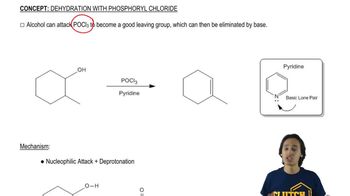
General Reaction of Dehydration with POCl3

Phosphorus Oxychloride (POCl3)

Phosphorus oxychloride (POCl3) is a reagent used for the conversion of alcohols to alkyl chlorides or for dehydration under mild conditions. It reacts with alcohols to form alkyl dichlorophosphate esters, which are more stable and can facilitate elimination reactions. The presence of good leaving groups, such as the dichlorophosphate group, enhances the efficiency of the dehydration process.
Video consigliato:
01:23
General Reaction of Dehydration with POCl3

Pyridine as a Base

Pyridine is a basic heterocyclic compound that can act as a nucleophile in organic reactions. In the context of dehydration, pyridine reacts with the alkyl dichlorophosphate ester formed from POCl3, facilitating an E2 elimination mechanism. This reaction pathway is favored under mild conditions, allowing for the formation of alkenes without the complications of rearrangements often seen in acid-catalyzed dehydration.
Video consigliato:
Percorso guidato
2:22
SNAr Reactions of Pyridine Concept 1