

Ch. 12 - Infrared Spectroscopy and Mass Spectrometry
Wade - Organic Chemistry 9th Edition
Wade9th EditionOrganic ChemistryISBN: 9780135213728Non è quello che usi tu?Cambia libro di testo
Capitolo 12, Problema 12a,b,c

Predict the characteristic infrared absorptions of the functional groups in the following molecules.
(a) cyclohexene
(b) pentan-2-ol
(c) pentan-2-one

Guida verificata passo dopo passo
1
Identify the functional groups present in each molecule. For cyclohexene, the functional group is a carbon-carbon double bond (C=C). For pentan-2-ol, the functional group is a hydroxyl group (-OH). For pentan-2-one, the functional group is a carbonyl group (C=O).
Recall the characteristic infrared absorption ranges for each functional group. The C=C bond in alkenes typically absorbs in the range of 1600-1680 cm⁻¹. The -OH group in alcohols shows a broad absorption around 3200-3600 cm⁻¹ due to hydrogen bonding. The C=O bond in ketones absorbs strongly in the range of 1700-1750 cm⁻¹.
For cyclohexene, predict the IR absorptions: Look for a peak in the range of 1600-1680 cm⁻¹ for the C=C stretch. Additionally, weak C-H stretching vibrations for sp² hybridized carbons may appear just above 3000 cm⁻¹.
For pentan-2-ol, predict the IR absorptions: Expect a broad, strong absorption around 3200-3600 cm⁻¹ for the -OH group. Also, look for C-H stretching vibrations for sp³ hybridized carbons in the range of 2800-3000 cm⁻¹.
For pentan-2-one, predict the IR absorptions: Look for a strong absorption in the range of 1700-1750 cm⁻¹ for the C=O stretch. Additionally, C-H stretching vibrations for sp³ hybridized carbons will appear in the range of 2800-3000 cm⁻¹.

Risposta video verificata per un problema simile:

Questa soluzione video è stata consigliata dai nostri tutor come utile per risolvere questo problema.
Durata del video:
4m

Concetti chiave

Ecco i concetti essenziali che devi comprendere per rispondere correttamente alla domanda.

Infrared Spectroscopy

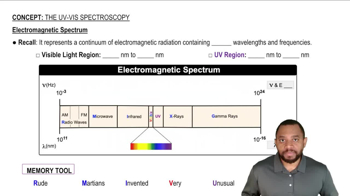
Infrared spectroscopy is a technique used to identify functional groups in organic compounds by measuring the absorption of infrared light. Different functional groups absorb characteristic wavelengths of infrared radiation, leading to distinct peaks in an IR spectrum. Understanding how these absorptions correlate with molecular vibrations is essential for predicting the IR spectra of given compounds.
Video consigliato:
Percorso guidato
2:56
The UV-Vis Spectroscopy Concept 1

Functional Groups

Functional groups are specific groups of atoms within molecules that are responsible for the characteristic chemical reactions of those molecules. Common functional groups include alcohols, ketones, and alkenes, each exhibiting unique IR absorption patterns. Identifying these groups in the provided molecules is crucial for predicting their infrared absorptions.
Video consigliato:
02:36
Identifying Functional Groups

Molecular Vibrations

Molecular vibrations refer to the oscillations of atoms within a molecule, which occur when energy is absorbed. These vibrations can be stretching or bending motions and are directly related to the frequencies of infrared light absorbed. The type and number of vibrations depend on the molecular structure and functional groups present, influencing the IR spectrum observed for each compound.
Video consigliato:
08:41
Review of Molecular Orbitals
Pratica correlata
Domanda del libro di testo

Ethers are not easily differentiated by their infrared spectra, but they tend to form predictable fragments in the mass spectrum. The following compounds give similar but distinctive mass spectra.

Both compounds give prominent peaks at m/z 116, 73, 57, and 43. But one compound gives a distinctive strong peak at 87, and the other compound gives a strong peak at 101. Determine which compound gives the peak at 87 and which one gives the peak at 101. Propose fragmentations to account for the ions at m/z 116, 101, 87, and 73.

1490
views
Domanda del libro di testo

Show the fragmentations that give rise to the peaks at m/z 43, 57, and 85 in the mass spectrum of 2,4-dimethylpentane (Figure 12-17).

<IMAGE>

2289
views
Domanda del libro di testo

Account for the peaks at m/z 87, 111, and 126 in the mass spectrum of 2,6-dimethylheptan-4-ol.

<IMAGE>

2124
views
Domanda del libro di testo

Convert the following infrared wavelengths to cm-1. (a) 6.24 𝜇m, typical for an aromatic C=C (b) 3.38 𝜇m, typical for a saturated C-H bond (c) 5.85 𝜇m, typical for a ketone carbonyl

1509
views
Domanda del libro di testo

Predict the characteristic infrared absorptions of the functional groups in the following molecules.

(d) pent-1-yne

(e) diethylamine

(f) pentanoic acid

1412
views
Domanda del libro di testo

Four infrared spectra are shown, corresponding to four of the following compounds. For each spectrum, determine the structure and explain how the peaks in the spectrum correspond to the structure you have chosen.

<IMAGE>

2036
views