
Ch. 13 - Nuclear Magnetic Resonance Spectroscopy
Wade - Organic Chemistry 9th Edition
Wade9th EditionOrganic ChemistryISBN: 9780135213728Non è quello che usi tu?Cambia libro di testo
Capitolo 13, Problema 10

An unknown compound (C3H2NCl) shows moderately strong IR absorptions around 1650 cm–1 and 2200 cm–1. Its NMR spectrum consists of two doublets (J = 14 Hz) at δ5.9 and δ7.1. Propose a structure consistent with these data.

Guida verificata passo dopo passo
1
Analyze the molecular formula (C3H2NCl): The compound contains 3 carbons, 2 hydrogens, 1 nitrogen, and 1 chlorine. This suggests the presence of unsaturation or a ring structure due to the low hydrogen count.
Interpret the IR absorptions: The absorption at 1650 cm⁻¹ indicates the presence of a C=C double bond or a C=O group, while the absorption at 2200 cm⁻¹ suggests a nitrile group (-C≡N). This aligns with the molecular formula containing nitrogen.
Examine the NMR spectrum: The two doublets at δ 5.9 and δ 7.1 ppm with a coupling constant (J = 14 Hz) indicate two protons in a trans relationship on a double bond (C=C). The chemical shifts suggest these protons are part of an unsaturated system, likely conjugated with an electron-withdrawing group.
Combine the data: The molecular formula, IR data, and NMR spectrum suggest a structure with a nitrile group (-C≡N), a trans C=C double bond, and a chlorine atom. The chlorine atom likely contributes to the electron-withdrawing effects observed in the NMR shifts.
Propose a structure: Based on the data, a plausible structure is trans-1-chloro-2-propenenitrile (ClCH=CH-C≡N), which satisfies the molecular formula, IR absorptions, and NMR splitting pattern.

Risposta video verificata per un problema simile:

Questa soluzione video è stata consigliata dai nostri tutor come utile per risolvere questo problema.
Durata del video:
9m

Concetti chiave

Ecco i concetti essenziali che devi comprendere per rispondere correttamente alla domanda.

Infrared (IR) Spectroscopy

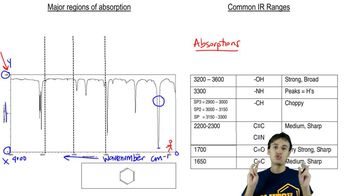
IR spectroscopy is a technique used to identify functional groups in organic compounds by measuring the absorption of infrared light at specific wavelengths. The presence of absorptions around 1650 cm-1 suggests the presence of a carbonyl (C=O) or an alkene (C=C), while the absorption near 2200 cm-1 indicates the presence of a nitrile (C≡N) or an alkyne (C≡C).
Video consigliato:
16:04
General Features of IR Spect

Nuclear Magnetic Resonance (NMR) Spectroscopy

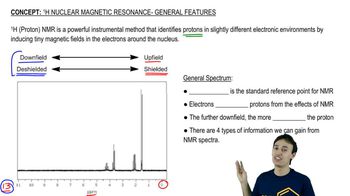
NMR spectroscopy provides information about the structure of organic compounds by analyzing the magnetic environment of nuclei, typically hydrogen (1H). The presence of two doublets at δ 5.9 and δ 7.1 ppm indicates that the compound has protons in different environments, likely due to adjacent protons causing splitting, which is characteristic of alkenes or aromatic systems.
Video consigliato:
10:06
General NMR Features

Chemical Structure Deduction

Chemical structure deduction involves using spectral data to propose a molecular structure that fits the given empirical formula and spectral characteristics. For the compound C3H2NCl, the combination of IR and NMR data suggests a structure that includes a double bond and possibly a nitrogen-containing functional group, guiding the identification of the compound's connectivity and arrangement.
Video consigliato:
Percorso guidato
3:11
Chemical Reactions of Phosphate Anhydrides Concept 1