Domanda del libro di testo
Draw the NMR spectrum expected from ethanol that has been shaken with a drop of D2O.
1596
views

 Wade 9th EditionCh. 13 - Nuclear Magnetic Resonance SpectroscopyProblema 18a,b
 Guida verificata passo dopo passo
 04:35
04:35
 11:44
11:44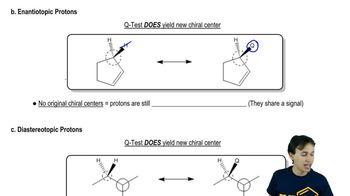 11:40
11:40Draw the NMR spectrum expected from ethanol that has been shaken with a drop of D2O.
Predict the theoretical number of different NMR signals produced by each compound, and give approximate chemical shifts. Point out any diastereotopic relationships.
c. Ph—CHBr—CH2Br
d. vinyl chloride
The spectrum of trans-hex-2-enoic acid follows.
(a) Assign peaks to show which protons give rise to which peaks in the spectrum.
(b) Draw a tree to show the complex splitting of the vinyl proton centered around 7 ppm. Estimate the values of the coupling constants.
If the imaginary replacement of either of two protons forms enantiomers, then those protons are said to be enantiotopic. The NMR is not a chiral probe, and it cannot distinguish between enantiotopic protons. They are seen to be “equivalent by NMR.”
(a) Use the imaginary replacement technique to show that the two allylic protons (those on C3) of allyl bromide are enantiotopic.
Propose mechanisms to show the interchange of protons between ethanol molecules under
(a) acid catalysis.
(b) base catalysis.
Draw a splitting tree, similar to Figures 13-32 and 13-33, for proton Hc in styrene. What is the chemical shift of proton Hc?