Ch. 14 - Ethers, Epoxides, and Thioethers
Wade - Organic Chemistry 9th Edition
Wade9th EditionOrganic ChemistryISBN: 9780135213728Non è quello che usi tu?Cambia libro di testo
Capitolo 14, Problema 10d

Show how the following ethers might be synthesized using (1) alkoxymercuration– demercuration and (2) the Williamson synthesis. (When one of these methods cannot be used for the given ether, point out why it will not work.)
(d) 1-methoxy-1-methylcyclopentane

Guida verificata passo dopo passo
1
Step 1: Understand the structure of the target ether, 1-methoxy-1-methylcyclopentane. It consists of a cyclopentane ring with a methyl group and a methoxy group (-OCH₃) attached to the same carbon atom (C1).
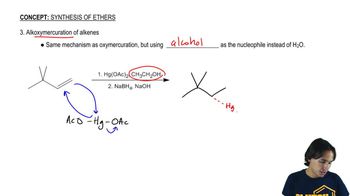
Step 2: For the alkoxymercuration–demercuration method, recall that this reaction involves the addition of an alcohol (ROH) to an alkene in the presence of mercuric acetate (Hg(OAc)₂) and water, followed by reduction with sodium borohydride (NaBH₄). Identify the corresponding alkene precursor for the ether. In this case, the precursor would be 1-methylcyclopentene, as the double bond would allow the addition of the methoxy group to the same carbon as the methyl group.
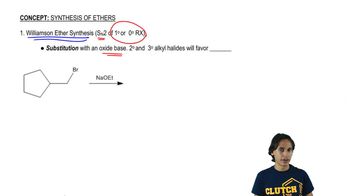
Step 3: For the Williamson synthesis, recall that this method involves the reaction of an alkoxide ion (R-O⁻) with a primary alkyl halide (R'-X) via an SN2 mechanism. Identify the possible alkoxide and alkyl halide precursors. Here, the alkoxide would be methoxide (CH₃O⁻), and the alkyl halide would need to be 1-bromo-1-methylcyclopentane. However, this reaction is unlikely to proceed efficiently because the carbon bearing the leaving group (Br) is tertiary, leading to steric hindrance and favoring elimination over substitution.
Step 4: Explain why the alkoxymercuration–demercuration method is suitable for this synthesis. The reaction proceeds regioselectively, with the methoxy group adding to the more substituted carbon of the alkene (Markovnikov addition). This ensures the correct placement of the methoxy group on the same carbon as the methyl group.
Step 5: Conclude that the Williamson synthesis is not a viable method for this ether due to steric hindrance at the tertiary carbon, which prevents the SN2 mechanism from occurring. Therefore, alkoxymercuration–demercuration is the preferred method for synthesizing 1-methoxy-1-methylcyclopentane.

Risposta video verificata per un problema simile:

Questa soluzione video è stata consigliata dai nostri tutor come utile per risolvere questo problema.
Durata del video:
7m

Concetti chiave

Ecco i concetti essenziali che devi comprendere per rispondere correttamente alla domanda.

Alkoxymercuration-Demercuration

Alkoxymercuration-demercuration is a two-step reaction used to synthesize ethers. In the first step, an alkene reacts with mercuric acetate in the presence of an alcohol, leading to the formation of an alkoxymercurial intermediate. The second step involves the reduction of this intermediate, typically using sodium borohydride, to yield the ether. This method is particularly useful for synthesizing ethers from alkenes, but it may not work for certain substrates due to steric hindrance or lack of suitable double bonds.
Video consigliato:
04:21
The Mechanism of Alkoxymercuation.

Williamson Ether Synthesis

The Williamson ether synthesis is a method for producing ethers through the nucleophilic substitution of an alkyl halide by an alkoxide ion. This reaction typically involves a strong base to generate the alkoxide from an alcohol, which then attacks the electrophilic carbon of the alkyl halide. This method is versatile and can be used for a variety of substrates, but it is limited by the requirement that the alkyl halide must be a primary or, in some cases, a secondary halide to avoid elimination reactions.
Video consigliato:
03:50
The Mechanism of Williamson Ether Synthesis.

Steric Hindrance

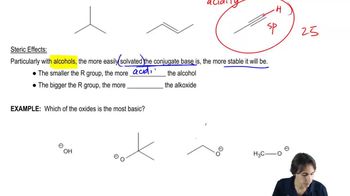
Steric hindrance refers to the prevention of chemical reactions due to the spatial arrangement of atoms within a molecule. In the context of ether synthesis, steric hindrance can affect the reactivity of substrates, particularly in nucleophilic substitution reactions like the Williamson synthesis. Bulky groups around the reactive site can hinder the approach of nucleophiles, making certain synthesis routes impractical or less efficient, especially when attempting to synthesize ethers from tertiary alkyl halides.
Video consigliato:
02:53
Understanding steric effects.
Pratica correlata