

Ch. 14 - Ethers, Epoxides, and Thioethers
Wade - Organic Chemistry 9th Edition
Wade9th EditionOrganic ChemistryISBN: 9780135213728Non è quello che usi tu?Cambia libro di testo
Capitolo 14, Problema 9d,e

Show how you would use the Williamson ether synthesis to prepare the following ethers. You may use any alcohols or phenols as your organic starting materials.
(d) ethyl n-propyl ether (two ways)
(e) benzyl tert-butyl ether (benzyl = Ph–CH2–)

Guida verificata passo dopo passo
1
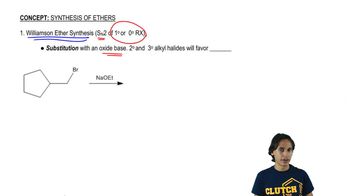
The Williamson ether synthesis involves the reaction of an alkoxide ion (RO⁻) with a primary alkyl halide (R'X) to form an ether (R-O-R'). The reaction proceeds via an SN2 mechanism, so the alkyl halide should ideally be primary to avoid steric hindrance.
For part (d), ethyl n-propyl ether (CH3CH2-O-CH2CH2CH3):
1. First method: Use ethanol (CH3CH2OH) as the alcohol. Deprotonate ethanol with a strong base (e.g., NaH or Na metal) to form the ethoxide ion (CH3CH2O⁻). Then, react the ethoxide ion with 1-bromopropane (CH3CH2CH2Br) or 1-chloropropane to form ethyl n-propyl ether.
2. Second method: Use 1-propanol (CH3CH2CH2OH) as the alcohol. Deprotonate 1-propanol with a strong base to form the propoxide ion (CH3CH2CH2O⁻). Then, react the propoxide ion with ethyl bromide (CH3CH2Br) or ethyl chloride to form ethyl n-propyl ether.
For part (e), benzyl tert-butyl ether (Ph-CH2-O-C(CH3)3):
1. Use benzyl alcohol (Ph-CH2OH) as the alcohol. Deprotonate benzyl alcohol with a strong base to form the benzyl alkoxide ion (Ph-CH2O⁻). Then, react the benzyl alkoxide ion with tert-butyl bromide (C(CH3)3Br) or tert-butyl chloride to form benzyl tert-butyl ether.
2. Alternatively, use tert-butanol (C(CH3)3OH) as the alcohol. Deprotonate tert-butanol with a strong base to form the tert-butoxide ion (C(CH3)3O⁻). Then, react the tert-butoxide ion with benzyl bromide (Ph-CH2Br) or benzyl chloride to form benzyl tert-butyl ether.

Risposta video verificata per un problema simile:

Questa soluzione video è stata consigliata dai nostri tutor come utile per risolvere questo problema.
Durata del video:
4m

Concetti chiave

Ecco i concetti essenziali che devi comprendere per rispondere correttamente alla domanda.

Williamson Ether Synthesis

The Williamson ether synthesis is a method for producing ethers through the reaction of an alkoxide ion with a primary alkyl halide. This reaction typically involves the nucleophilic substitution mechanism (SN2), where the alkoxide acts as a nucleophile, attacking the electrophilic carbon of the alkyl halide, resulting in the formation of an ether. This method is particularly effective for synthesizing simple ethers and requires careful selection of starting materials to avoid side reactions.
Video consigliato:
03:50
The Mechanism of Williamson Ether Synthesis.

Nucleophilic Substitution Reactions

Nucleophilic substitution reactions are fundamental reactions in organic chemistry where a nucleophile replaces a leaving group in a molecule. In the context of the Williamson ether synthesis, the alkoxide ion serves as the nucleophile, while the alkyl halide provides the leaving group. Understanding the mechanisms of SN2 and SN1 reactions is crucial, as the choice of substrate (primary, secondary, or tertiary) influences the reaction pathway and the efficiency of ether formation.
Video consigliato:
01:47
Nucleophiles and Electrophiles can react in Substitution Reactions.

Reactivity of Alcohols and Phenols

Alcohols and phenols can be converted into alkoxide ions, which are essential for the Williamson ether synthesis. The reactivity of these compounds varies; for instance, primary alcohols are more readily converted to alkoxides and are preferred for SN2 reactions. Phenols, while less nucleophilic than alkoxides, can also participate in ether synthesis when treated with strong bases. Understanding the properties and reactivity of these starting materials is vital for designing effective synthetic routes to ethers.
Video consigliato:
Percorso guidato
1:47
Oxidation of Phenols to Quinones Concept 1