Ch. 14 - Ethers, Epoxides, and Thioethers
Wade - Organic Chemistry 9th Edition
Wade9th EditionOrganic ChemistryISBN: 9780135213728Non è quello che usi tu?Cambia libro di testo
Capitolo 14, Problema 34a,b,c

Show how you would make the following ethers, using only simple alcohols and any needed reagents as your starting materials.
(a) 1-methoxybutane
(b) 2-ethoxy-2-methylpropane
(c) benzyl cyclopentyl ether

Guida verificata passo dopo passo
1
Step 1: Understand the Williamson Ether Synthesis, which is a common method for preparing ethers. It involves the reaction of an alkoxide ion (RO⁻) with a primary alkyl halide (R'X) via an SN2 mechanism. This method is particularly useful for synthesizing ethers from simple alcohols.
Step 2: For (a) 1-methoxybutane, start with methanol (CH₃OH) and 1-bromobutane (CH₃CH₂CH₂CH₂Br). First, deprotonate methanol using a strong base like sodium hydride (NaH) to form the methoxide ion (CH₃O⁻). Then, react the methoxide ion with 1-bromobutane in an SN2 reaction to form 1-methoxybutane.
Step 3: For (b) 2-ethoxy-2-methylpropane, start with ethanol (CH₃CH₂OH) and 2-bromo-2-methylpropane ((CH₃)₃CBr). Deprotonate ethanol using a strong base like sodium hydride (NaH) to form the ethoxide ion (CH₃CH₂O⁻). Then, react the ethoxide ion with 2-bromo-2-methylpropane in an SN2 reaction to form 2-ethoxy-2-methylpropane.
Step 4: For (c) benzyl cyclopentyl ether, start with benzyl alcohol (C₆H₅CH₂OH) and cyclopentanol (C₅H₉OH). First, convert benzyl alcohol to benzyl bromide (C₆H₅CH₂Br) using a reagent like phosphorus tribromide (PBr₃). Then, deprotonate cyclopentanol using a strong base like sodium hydride (NaH) to form the cyclopentoxide ion (C₅H₉O⁻). Finally, react the cyclopentoxide ion with benzyl bromide in an SN2 reaction to form benzyl cyclopentyl ether.
Step 5: Verify the reaction conditions for each step to ensure compatibility with the SN2 mechanism. For example, avoid using bulky alkyl halides or strong bases with secondary or tertiary alkyl halides, as these can lead to elimination reactions instead of substitution.

Risposta video verificata per un problema simile:

Questa soluzione video è stata consigliata dai nostri tutor come utile per risolvere questo problema.
Durata del video:
12m

Concetti chiave

Ecco i concetti essenziali che devi comprendere per rispondere correttamente alla domanda.

Ethers and Their Formation

Ethers are organic compounds characterized by an oxygen atom bonded to two alkyl or aryl groups. They can be synthesized through the dehydration of alcohols, where two alcohol molecules react in the presence of an acid catalyst to form an ether and water. Understanding this reaction mechanism is crucial for constructing the desired ethers from simple alcohols.
Video consigliato:
04:22
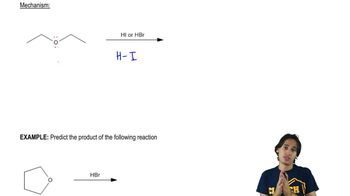
How to predict the products of Ether Cleavage.

Williamson Ether Synthesis

The Williamson Ether Synthesis is a key method for producing ethers, involving the nucleophilic substitution of an alkoxide ion with a primary alkyl halide. This reaction is particularly useful for creating complex ethers from simpler alcohols, as it allows for the selective formation of the ether bond. Recognizing the role of nucleophiles and electrophiles in this process is essential for the synthesis outlined in the question.
Video consigliato:
03:50
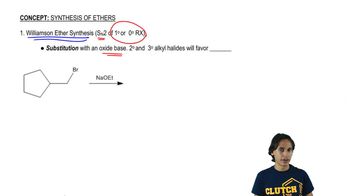
The Mechanism of Williamson Ether Synthesis.

Reactivity of Alcohols

Alcohols can act as both nucleophiles and electrophiles in organic reactions, depending on the conditions. Their reactivity is influenced by factors such as steric hindrance and the presence of acidic or basic conditions. Understanding how to manipulate these properties is vital for effectively synthesizing the specified ethers from simple alcohols, as it determines the choice of reagents and reaction pathways.
Video consigliato:
01:01
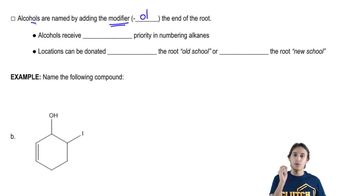
How to name alcohols
Pratica correlata
Domanda del libro di testo

The following reaction resembles the acid-catalyzed cyclization of squalene oxide. Propose a mechanism for this reaction.

999
views

Domanda del libro di testo

Predict the products of the following reactions.

(j)

(k)

(l)

1600
views
Domanda del libro di testo

(A true story.) An inexperienced graduate student moved into a laboratory and began work. He needed some diethyl ether for a reaction, so he opened an old, rusty 1-gallon can marked 'ethyl ether' and found there was half a gallon left. To purify the ether, the student set up a distillation apparatus, started a careful distillation, and went to the stockroom for the other reagents he needed. While he was at the stockroom, the student heard a muffled "boom." He quickly returned to his lab to find a worker from another laboratory putting out a fire. Most of the distillation apparatus was embedded in the ceiling.

(a) Explain what probably happened.

(b) Explain how this near-disaster might have been prevented.

1202
views
Domanda del libro di testo

(a) Show how you would synthesize the pure (R) enantiomer of 2-butyl methyl sulfide, starting with pure (R)-butan-2-ol and any reagents you need

(b) Show how you would synthesize the pure (S) enantiomer of the product, still starting with (R)-butan-2-ol and any reagents you need.

737
views
Domanda del libro di testo

Predict the products of the following reactions.

(g) trans-2,3-epoxyoctane + H+, H2O

(h) propylene oxide + methylamine (CH3NH2)

1291
views
Domanda del libro di testo

Predict the products of the following reactions.

(m)

(n)

1780
views