Ch. 14 - Ethers, Epoxides, and Thioethers
Wade - Organic Chemistry 9th Edition
Wade9th EditionOrganic ChemistryISBN: 9780135213728Non è quello che usi tu?Cambia libro di testo
Capitolo 14, Problema 39

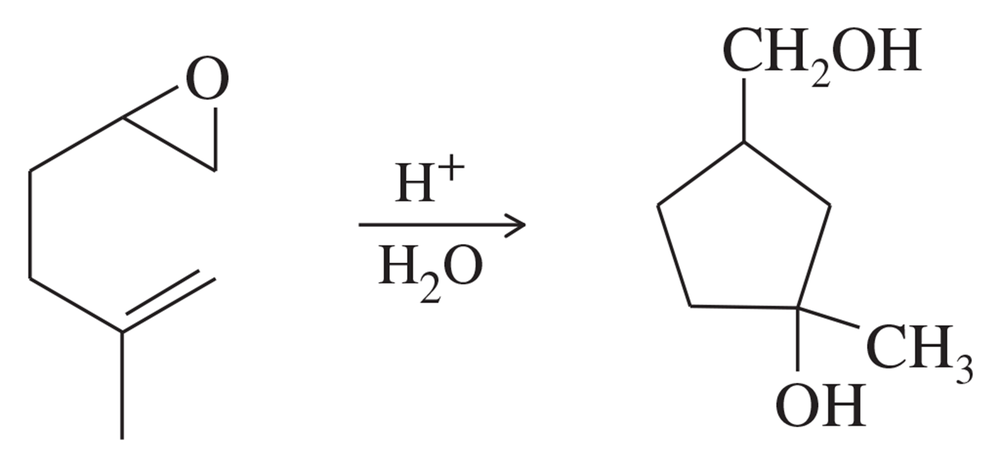
The following reaction resembles the acid-catalyzed cyclization of squalene oxide. Propose a mechanism for this reaction.

Guida verificata passo dopo passo
1
Step 1: Protonation of the epoxide group occurs first. The acidic environment (H⁺) protonates the oxygen atom in the epoxide, making it more electrophilic and susceptible to nucleophilic attack. This step generates a positively charged intermediate.
Step 2: The protonated epoxide undergoes ring opening. The strain in the three-membered ring is relieved as one of the bonds between the oxygen and carbon breaks, forming a carbocation intermediate. The position of the carbocation depends on the stability of the resulting structure.
Step 3: A hydride shift or methyl shift may occur to stabilize the carbocation. This rearrangement leads to the formation of a more stable tertiary carbocation, which is crucial for the subsequent cyclization step.
Step 4: Intramolecular nucleophilic attack occurs. The hydroxyl group (from water) attacks the carbocation, leading to the formation of a new bond and initiating the cyclization process. This step forms a cyclic intermediate.
Step 5: Deprotonation occurs to neutralize the intermediate. A water molecule or another base removes the excess proton, resulting in the final product with two hydroxyl groups and a methyl group attached to the cyclized structure.

Risposta video verificata per un problema simile:

Questa soluzione video è stata consigliata dai nostri tutor come utile per risolvere questo problema.
Durata del video:
2m

Concetti chiave

Ecco i concetti essenziali che devi comprendere per rispondere correttamente alla domanda.

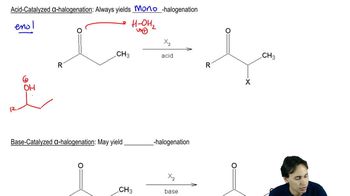
Acid-Catalyzed Reactions

Acid-catalyzed reactions involve the use of an acid to increase the rate of a chemical reaction. In organic chemistry, acids can protonate reactants, making them more electrophilic and facilitating nucleophilic attacks. This is crucial in mechanisms like the cyclization of squalene oxide, where the acid activates the carbonyl group, promoting the formation of cyclic structures.
Video consigliato:
03:09
Acid Catalyzed

Cyclization Mechanisms

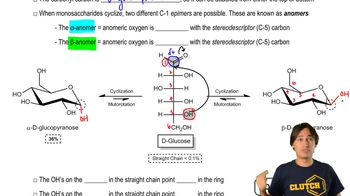
Cyclization mechanisms refer to the processes by which linear or branched molecules form cyclic structures. In the case of squalene oxide, the reaction involves the formation of a ring through the nucleophilic attack of a hydroxyl group on a carbocation intermediate. Understanding the steps of cyclization is essential for predicting the products and intermediates in such reactions.
Video consigliato:
12:58
Monosaccharides - Cyclization

Squalene and Its Derivatives

Squalene is a natural organic compound and a precursor to many steroids and terpenes. Its derivatives, like squalene oxide, undergo various transformations, including cyclization, under acidic conditions. Familiarity with the structure and reactivity of squalene and its derivatives is important for understanding the specific reaction mechanism and the resulting products in the context of organic synthesis.
Video consigliato:
02:49
Ammonia Derivatives
Pratica correlata
Domanda del libro di testo

Show how you would make the following ethers, using only simple alcohols and any needed reagents as your starting materials.

(a) 1-methoxybutane

(b) 2-ethoxy-2-methylpropane

(c) benzyl cyclopentyl ether

1291
views
1
rank

Domanda del libro di testo

Both LiAlH4 and Grignard reagents react with carbonyl compounds to give alkoxide ion intermediates (that become protonated in an aqueous workup). Those alkoxides can react with 1° or methyl alkyl halides or tosylates to give ethers. Show how the following ethers can be formed in this two-step process. As starting materials you may use any reactants containing 7 carbons or fewer.

(b)

614
views
Domanda del libro di testo

Both LiAlH4 and Grignard reagents react with carbonyl compounds to give alkoxide ion intermediates (that become protonated in an aqueous workup). Those alkoxides can react with 1° or methyl alkyl halides or tosylates to give ethers. Show how the following ethers can be formed in this two-step process. As starting materials you may use any reactants containing 7 carbons or fewer.

(a)

762
views
Domanda del libro di testo

(A true story.) An inexperienced graduate student moved into a laboratory and began work. He needed some diethyl ether for a reaction, so he opened an old, rusty 1-gallon can marked 'ethyl ether' and found there was half a gallon left. To purify the ether, the student set up a distillation apparatus, started a careful distillation, and went to the stockroom for the other reagents he needed. While he was at the stockroom, the student heard a muffled "boom." He quickly returned to his lab to find a worker from another laboratory putting out a fire. Most of the distillation apparatus was embedded in the ceiling.

(a) Explain what probably happened.

(b) Explain how this near-disaster might have been prevented.

1202
views
Domanda del libro di testo

(a) Show how you would synthesize the pure (R) enantiomer of 2-butyl methyl sulfide, starting with pure (R)-butan-2-ol and any reagents you need

(b) Show how you would synthesize the pure (S) enantiomer of the product, still starting with (R)-butan-2-ol and any reagents you need.

737
views
Domanda del libro di testo

Show how you would convert hex-1-ene to each of the following compounds. You may use any additional reagents and solvents you need.

(a) 2-methoxyhexane

(b) 1-methoxyhexane

(c) 1-methoxyhexan-2-ol

1450
views