Ch. 15 - Conjugated Systems, Orbital Symmetry, and Ultraviolet Spectroscopy
Wade - Organic Chemistry 9th Edition
Wade9th EditionOrganic ChemistryISBN: 9780135213728Non è quello che usi tu?Cambia libro di testo
Capitolo 15, Problema 29b

The diene lactone shown in part (a) has one electron-donating group (-OR) and one electron-withdrawing group (C=O). This diene lactone is sufficiently electron-rich to serve as the diene in a Diels–Alder reaction.
Diene lactone structure with electron-donating and withdrawing groups leading to an unstable Diels–Alder product A.


b. The Diels–Alder product A is not very stable. Upon mild heating, it reacts to produce CO2 gas and methyl benzoate (PhCOOCH3), a very stable product. Explain how this strongly exothermic decarboxylation takes place. (Hint: Under the right conditions, the Diels–Alder reaction can be reversible.)

Guida verificata passo dopo passo
1
Step 1: Analyze the diene lactone structure. The diene lactone contains a conjugated diene system with one electron-donating group (-OR) and one electron-withdrawing group (C=O). These groups influence the electron density of the diene, making it electron-rich and suitable for a Diels–Alder reaction with an electron-deficient dienophile.
Step 2: Examine the dienophile, methyl acetylene carboxylate. This molecule contains a triple bond (C≡C) and an electron-withdrawing ester group (-COOCH3), making it electron-deficient and reactive toward the electron-rich diene lactone in the Diels–Alder reaction.
Step 3: Describe the Diels–Alder reaction mechanism. The diene lactone reacts with the dienophile to form a cyclic adduct (product A). This reaction involves a [4+2] cycloaddition, where the diene contributes four π-electrons and the dienophile contributes two π-electrons to form a new six-membered ring.
Step 4: Explain the instability of product A. Product A is unstable due to strain in the newly formed ring and the presence of functional groups that can undergo further reactions. Upon mild heating, product A undergoes a retro-Diels–Alder reaction, releasing CO2 gas and forming methyl benzoate (PhCOOCH3).
Step 5: Discuss the decarboxylation process. The retro-Diels–Alder reaction is strongly exothermic because it releases CO2, a stable gas, and forms methyl benzoate, a thermodynamically stable aromatic compound. This drives the reaction forward under mild heating conditions.

Risposta video verificata per un problema simile:

Questa soluzione video è stata consigliata dai nostri tutor come utile per risolvere questo problema.
Durata del video:
2m

Concetti chiave

Ecco i concetti essenziali che devi comprendere per rispondere correttamente alla domanda.

Diels–Alder Reaction

The Diels–Alder reaction is a [4+2] cycloaddition between a conjugated diene and a dienophile, forming a six-membered ring. This reaction is significant in organic synthesis due to its ability to create complex cyclic structures in a single step. The electron-rich diene and electron-poor dienophile interact to form a new sigma bond, making it a valuable tool for constructing various organic compounds.
Video consigliato:
04:02
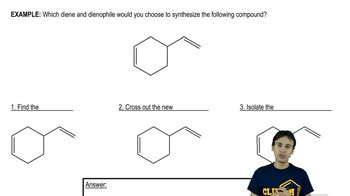
Diels-Alder Retrosynthesis

Decarboxylation

Decarboxylation is the process of removing a carboxyl group (-COOH) from a molecule, resulting in the release of carbon dioxide (CO2). This reaction often occurs in organic compounds under heat or catalytic conditions, leading to more stable products. In the context of the Diels–Alder product, decarboxylation can enhance stability by converting a less stable intermediate into a more stable compound, such as methyl benzoate.
Video consigliato:
02:32
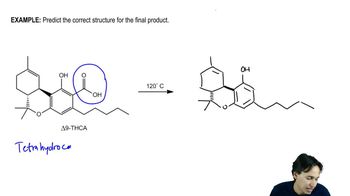
Predict the correct structure

Reversibility of Diels–Alder Reaction

The Diels–Alder reaction can be reversible under certain conditions, particularly when the reaction is conducted at elevated temperatures or when the products are less stable. This reversibility allows the reaction to shift back to the reactants, facilitating the formation of more stable products through subsequent reactions, such as decarboxylation. Understanding this concept is crucial for predicting the behavior of Diels–Alder adducts in various chemical environments.
Video consigliato:
04:02
Diels-Alder Retrosynthesis