Ch. 16 - Aromatic Compounds
Wade - Organic Chemistry 9th Edition
Wade9th EditionOrganic ChemistryISBN: 9780135213728Non è quello che usi tu?Cambia libro di testo
Capitolo 16, Problema 16c

Draw resonance forms to show the charge distribution on the pyrrole structure.

Guida verificata passo dopo passo
1
Step 1: Recognize the pyrrole structure. Pyrrole is a five-membered aromatic ring containing one nitrogen atom. The nitrogen has a lone pair of electrons, and the ring is conjugated with alternating double bonds.
Step 2: Understand resonance in aromatic systems. Resonance occurs when electrons can delocalize across the conjugated system, stabilizing the molecule. In pyrrole, the lone pair on nitrogen can participate in resonance with the π-electrons of the ring.
Step 3: Draw the first resonance form. In this form, the lone pair on nitrogen moves to form a double bond between nitrogen and one of the adjacent carbon atoms. This causes the double bond in the ring to shift, creating a new resonance structure.
Step 4: Draw the second resonance form. In this form, the double bond from the previous step shifts further around the ring, and the negative charge appears on a different carbon atom. This continues the delocalization of electrons.
Step 5: Draw the third resonance form. The double bond shifts again, placing the negative charge on yet another carbon atom. This completes the set of resonance structures for pyrrole, showing how the charge is distributed across the ring.

Risposta video verificata per un problema simile:

Questa soluzione video è stata consigliata dai nostri tutor come utile per risolvere questo problema.
Durata del video:
7m

Concetti chiave

Ecco i concetti essenziali che devi comprendere per rispondere correttamente alla domanda.

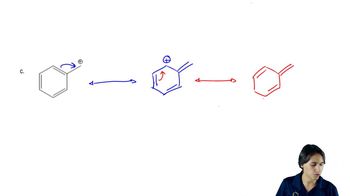
Resonance Structures

Resonance structures are different Lewis structures for the same molecule that illustrate the delocalization of electrons. In the case of pyrrole, resonance forms show how the nitrogen atom can share its lone pair with the π system of the ring, leading to multiple valid representations of the molecule's electron distribution.
Video consigliato:
03:04
Drawing Resonance Structures

Aromaticity

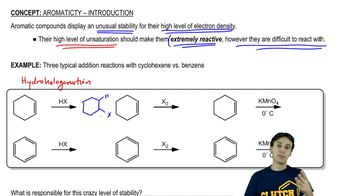
Aromaticity refers to the enhanced stability of cyclic compounds with conjugated π electrons that follow Hückel's rule (4n + 2 π electrons). Pyrrole is aromatic due to its five-membered ring containing a nitrogen atom, which contributes to the π system, allowing for resonance stabilization and unique chemical properties.
Video consigliato:
08:19
Intro to Aromaticity

Charge Distribution

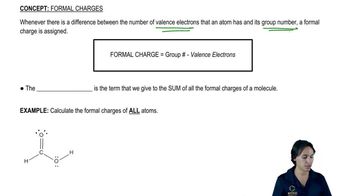
Charge distribution in a molecule refers to how electron density is spread across its atoms. In pyrrole, the resonance forms illustrate that the charge is not localized but rather delocalized over the ring, affecting its reactivity and interactions with other molecules, particularly in electrophilic aromatic substitution reactions.
Video consigliato:
01:34
Calculating formal and net charge.