Ch. 16 - Aromatic Compounds
Wade - Organic Chemistry 9th Edition
Wade9th EditionOrganic ChemistryISBN: 9780135213728Non è quello che usi tu?Cambia libro di testo
Capitolo 16, Problema 17

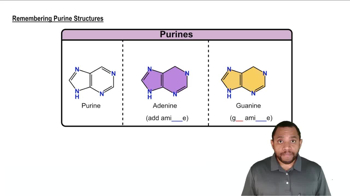
Show which of the nitrogen atoms in purine are basic, and which one is not basic. For the nonbasic nitrogen, explain why its nonbonding electrons are not easily available to become protonated.

Guida verificata passo dopo passo
1
Step 1: Begin by identifying the structure of purine. Purine is a heterocyclic aromatic compound with a fused ring system consisting of a pyrimidine ring and an imidazole ring. It contains four nitrogen atoms in total.
Step 2: Analyze the electronic environment of each nitrogen atom. In aromatic systems, the basicity of nitrogen atoms depends on whether their lone pairs are involved in the aromatic π-system or are free to accept a proton.
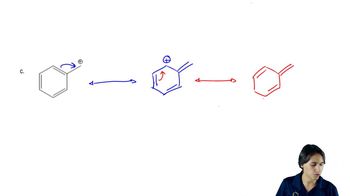
Step 3: For the nitrogen atoms in purine, determine their roles in the aromatic system. Use resonance structures to see if the lone pairs of electrons on the nitrogen atoms are delocalized into the π-system. Nitrogen atoms with delocalized lone pairs are not basic because their electrons are not readily available for protonation.
Step 4: Identify the basic nitrogen atoms. Nitrogen atoms whose lone pairs are not involved in the aromatic π-system are basic because their electrons are free to accept a proton. These nitrogen atoms can act as proton acceptors.
Step 5: Explain why the nonbasic nitrogen atom is not basic. The lone pair of electrons on this nitrogen is delocalized into the aromatic π-system, contributing to the stability of the aromatic ring. Because these electrons are part of the conjugated π-system, they are not easily available for protonation, making the nitrogen atom nonbasic.

Risposta video verificata per un problema simile:

Questa soluzione video è stata consigliata dai nostri tutor come utile per risolvere questo problema.
Durata del video:
5m

Concetti chiave

Ecco i concetti essenziali che devi comprendere per rispondere correttamente alla domanda.

Basicity of Nitrogen Atoms

Basicity in organic chemistry refers to the ability of a nitrogen atom to accept a proton (H+). Nitrogen atoms in purine can vary in their basicity depending on their electronic environment and hybridization. Typically, nitrogen atoms with a lone pair of electrons in a suitable orbital can act as bases, while those involved in aromatic systems or with electron-withdrawing groups may be less basic.
Video consigliato:
Percorso guidato
1:45
Nitrogenous Bases Concept 3

Structure of Purine

Purine is a bicyclic compound consisting of a fused imidazole and pyrimidine ring. It contains four nitrogen atoms, each positioned differently within the rings. Understanding the spatial arrangement and hybridization of these nitrogen atoms is crucial for determining which are basic and which are not, as their electronic properties are influenced by their connectivity and the overall molecular structure.
Video consigliato:
03:04
Drawing Resonance Structures

Nonbonding Electrons and Protonation

Nonbonding electrons are lone pairs that are not involved in covalent bonding. For a nitrogen atom to be basic, its nonbonding electrons must be available to accept a proton. In the case of the nonbasic nitrogen in purine, steric hindrance or resonance stabilization can delocalize these electrons, making them less available for protonation, thus reducing the atom's basicity.
Video consigliato:
03:54
The 18 and 16 Electron Rule