Ch. 16 - Aromatic Compounds
Wade - Organic Chemistry 9th Edition
Wade9th EditionOrganic ChemistryISBN: 9780135213728Non è quello che usi tu?Cambia libro di testo
Capitolo 16, Problema 9c

Drawpictorialrepresentations (as in Figures16-4 and 16-6) for the three bonding MOs and the two nonbonding MOs of cyclooctatetraene. The antibonding MOs are difficult to draw, except for the all-antibonding MO.
Molecular orbital diagram of cyclooctatetraene showing bonding and nonbonding orbitals with positive and negative lobes.

Guida verificata passo dopo passo
1
Step 1: Cyclooctatetraene has eight π-electrons, and its molecular orbitals (MOs) can be constructed using symmetry principles. Begin by identifying the bonding, nonbonding, and antibonding molecular orbitals. Bonding MOs will have constructive overlap of p orbitals, nonbonding MOs will have no net overlap, and antibonding MOs will have destructive overlap.
Step 2: Draw the three bonding MOs. These will have increasing numbers of nodes (regions where the wave function changes sign). The lowest energy bonding MO will have no nodes, the next will have one node, and the third will have two nodes. Represent the constructive overlap of p orbitals pictorially, ensuring the phases (+ and -) are consistent.
Step 3: Draw the two nonbonding MOs. These orbitals will have a configuration where the p orbitals do not interact constructively or destructively, resulting in no net bonding or antibonding character. Indicate the phases of the p orbitals and ensure the symmetry matches the molecular structure.
Step 4: For the antibonding MOs, focus on the all-antibonding MO (π₈*), which is the highest energy orbital. This orbital will have maximum nodes (seven nodes for cyclooctatetraene) and complete destructive overlap of all p orbitals. Use the image provided as a reference to depict the alternating phases (+ and -) around the ring.
Step 5: Label each MO clearly with its energy level and symmetry properties. Ensure the pictorial representations are consistent with the molecular geometry and the number of π-electrons in cyclooctatetraene.

Risposta video verificata per un problema simile:

Questa soluzione video è stata consigliata dai nostri tutor come utile per risolvere questo problema.
Durata del video:
4m

Concetti chiave

Ecco i concetti essenziali che devi comprendere per rispondere correttamente alla domanda.

Molecular Orbitals (MOs)

Molecular orbitals are formed by the linear combination of atomic orbitals when atoms bond together. They can be classified as bonding, nonbonding, or antibonding based on their energy levels and stability. Bonding MOs lower the energy of the system and stabilize the molecule, while antibonding MOs increase energy and destabilize it. Understanding MOs is crucial for predicting the behavior of electrons in molecules like cyclooctatetraene.
Video consigliato:
08:41
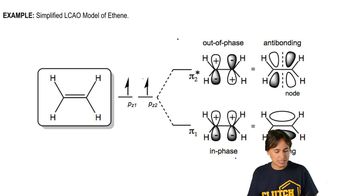
Review of Molecular Orbitals

Cyclooctatetraene Structure

Cyclooctatetraene is a cyclic hydrocarbon with eight carbon atoms and alternating double bonds. Its unique structure allows for the presence of both bonding and nonbonding molecular orbitals. The molecule is known for its non-planarity, which affects its electronic properties and stability. Recognizing the geometry and hybridization of cyclooctatetraene is essential for accurately drawing its molecular orbitals.
Video consigliato:
03:04
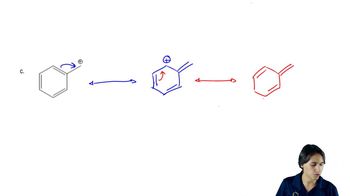
Drawing Resonance Structures

Bonding vs. Nonbonding MOs

Bonding molecular orbitals are formed when atomic orbitals combine constructively, leading to increased electron density between nuclei, which stabilizes the molecule. Nonbonding molecular orbitals, on the other hand, result from atomic orbitals that do not interact significantly with others, thus not contributing to bonding. Understanding the distinction between these types of MOs is vital for analyzing the electronic structure of cyclooctatetraene and predicting its reactivity.
Video consigliato:
06:00
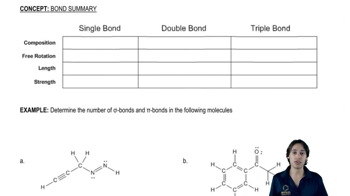
Single bonds, double bonds, and triple bonds.
Pratica correlata
Domanda del libro di testo

Classify the following compounds as aromatic, antiaromatic, or nonaromatic.

(c)

(d)

1726
views

Domanda del libro di testo

One of the following compounds is much more stable than the other two. Classify each as aromatic, antiaromatic, or nonaromatic.

896
views
Domanda del libro di testo

(a) Draw the molecular orbitals for the cyclopropenyl case.

(Because there are three p orbitals, there must be three MOs: one all-bonding MO and one degenerate pair of MOs.)

(b) Draw an energy diagram for the cyclopropenyl MOs. (The polygon rule is helpful.) Label each MO as bonding, nonbonding, or antibonding, and add the nonbonding line. Notice that it goes through the approximate average of the MOs.

(c) Add electrons to your energy diagram to show the configuration of the cyclopropenyl cation and the cyclopropenyl anion. Which is aromatic and which is antiaromatic?

1324
views
Domanda del libro di testo

a. Use the polygon rule to draw an energy diagram (as in Figures 16-5 and 16-7) for the MOs of a planar cyclooctatetraenyl system.

b. Fill in the eight pi electrons for cyclooctatetraene. Is this electronic configuration aromatic or antiaromatic? Could the cyclooctatetraene system be aromatic if it gained or lost electrons?

764
views
Domanda del libro di testo

Repeat Problem 16-10 for the cyclopentadienyl ions. Draw one all-bonding MO, then a pair of degenerate MOs, and then a final pair of degenerate MOs. Draw the energy diagram, fill in the electrons, and confirm the electronic configurations of the cyclopentadienyl cation and anion.

879
views
Domanda del libro di testo

Explain why each compound or ion should be aromatic, antiaromatic, or nonaromatic.

(a)

(b)

(c)

1352
views