Ch. 16 - Aromatic Compounds
Wade - Organic Chemistry 9th Edition
Wade9th EditionOrganic ChemistryISBN: 9780135213728Non è quello che usi tu?Cambia libro di testo
Capitolo 16, Problema 7c,d

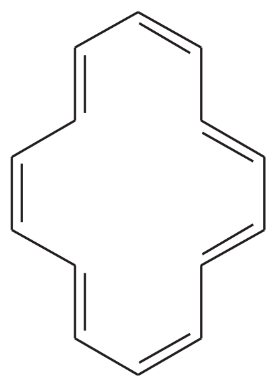
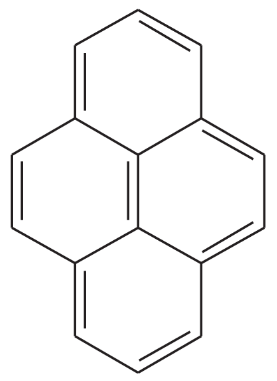
Classify the following compounds as aromatic, antiaromatic, or nonaromatic.
(c)
(d)

Guida verificata passo dopo passo
1
Step 1: Recall the criteria for aromaticity. A compound is aromatic if it satisfies the following conditions: (a) It is cyclic, (b) It is planar, (c) It has a conjugated π-electron system, and (d) It follows Huckel's rule, which states that the molecule must have (4n + 2) π-electrons, where n is a non-negative integer.
Step 2: Analyze compound (c). The structure is cyclic and planar, and it has alternating double bonds, indicating conjugation. Count the π-electrons in the conjugated system. Each double bond contributes 2 π-electrons. Verify if the total number of π-electrons satisfies Huckel's rule.
Step 3: Analyze compound (d). The structure is cyclic and planar, and it has alternating double bonds, indicating conjugation. Count the π-electrons in the conjugated system. Each double bond contributes 2 π-electrons. Verify if the total number of π-electrons satisfies Huckel's rule.
Step 4: Determine if the compounds are antiaromatic. A compound is antiaromatic if it is cyclic, planar, conjugated, but does not satisfy Huckel's rule and instead has 4n π-electrons, leading to instability.
Step 5: If the compounds do not satisfy the criteria for aromaticity or antiaromaticity, classify them as nonaromatic. Nonaromatic compounds are either non-cyclic, non-planar, or lack conjugation.

Risposta video verificata per un problema simile:

Questa soluzione video è stata consigliata dai nostri tutor come utile per risolvere questo problema.
Durata del video:
8m

Concetti chiave

Ecco i concetti essenziali che devi comprendere per rispondere correttamente alla domanda.

Aromaticity

Aromatic compounds are cyclic, planar molecules with a ring of resonance bonds that follow Hückel's rule, which states they must have 4n + 2 π electrons (where n is a non-negative integer). This unique electron configuration leads to increased stability and distinct chemical properties, such as lower reactivity compared to aliphatic compounds.
Video consigliato:
08:19
Intro to Aromaticity

Antiaromaticity

Antiaromatic compounds are also cyclic and planar but contain 4n π electrons, which leads to instability and higher reactivity. The presence of this electron configuration results in significant strain within the molecule, making antiaromatic compounds less favorable in chemical reactions compared to both aromatic and nonaromatic compounds.
Video consigliato:
02:58
Determine the aromaticity

Nonaromatic Compounds

Nonaromatic compounds do not meet the criteria for aromaticity or antiaromaticity. They may be acyclic, not planar, or lack a complete conjugated π system. As a result, these compounds do not exhibit the unique stability associated with aromatic compounds and typically behave like aliphatic compounds in chemical reactions.
Video consigliato:
01:40
Defining meso compounds.