Ch. 16 - Aromatic Compounds
Wade - Organic Chemistry 9th Edition
Wade9th EditionOrganic ChemistryISBN: 9780135213728Non è quello che usi tu?Cambia libro di testo
Capitolo 16, Problema 35f

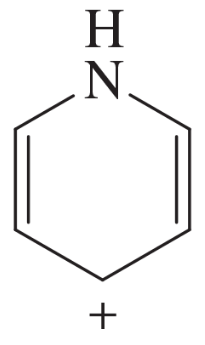
Some of the following compounds show aromatic properties, and others do not.
1. Predict which ones are likely to be aromatic, and explain why they are aromatic.
2. Predict which nitrogen atoms are more basic than water and which are less basic.
(f)

Guida verificata passo dopo passo
1
Step 1: Analyze the structure of the compound provided. The image shows a six-membered ring with alternating double bonds (a conjugated system) and a positively charged nitrogen atom with a hydrogen attached. This structure resembles pyridinium.
Step 2: Determine aromaticity using Huckel's rule. Huckel's rule states that a compound is aromatic if it is cyclic, planar, fully conjugated, and contains (4n + 2) π electrons, where n is an integer. Count the π electrons in the conjugated system of the ring.
Step 3: Evaluate the π electron count. The ring has three double bonds, contributing 6 π electrons. Since 6 π electrons satisfy Huckel's rule (4n + 2, where n = 1), the compound is aromatic.
Step 4: Assess the basicity of the nitrogen atom. The nitrogen in pyridinium is positively charged, which significantly reduces its ability to donate electrons. Therefore, this nitrogen is less basic than water.
Step 5: Summarize the findings. The compound is aromatic due to its cyclic, planar, conjugated structure and 6 π electrons. The nitrogen atom is less basic than water because it is positively charged and unable to effectively donate electrons.

Risposta video verificata per un problema simile:

Questa soluzione video è stata consigliata dai nostri tutor come utile per risolvere questo problema.
Durata del video:
4m

Concetti chiave

Ecco i concetti essenziali che devi comprendere per rispondere correttamente alla domanda.

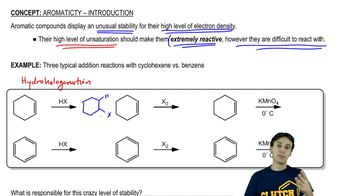
Aromaticity

Aromaticity refers to the special stability and unique properties of cyclic compounds that follow Hückel's rule, which states that a molecule must have (4n + 2) π electrons, where n is a non-negative integer. Aromatic compounds are typically planar, fully conjugated, and exhibit resonance, leading to lower reactivity compared to non-aromatic compounds. The presence of a nitrogen atom in a ring can influence aromaticity depending on its hybridization and the electron density it contributes.
Video consigliato:
08:19
Intro to Aromaticity

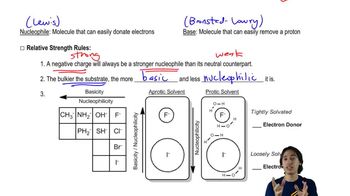
Basicity of Nitrogen

The basicity of nitrogen atoms in organic compounds is determined by their ability to donate a lone pair of electrons. Factors such as hybridization, electronegativity, and the presence of electron-withdrawing or electron-donating groups affect basicity. In general, sp3-hybridized nitrogen is more basic than sp2-hybridized nitrogen due to the greater availability of the lone pair for protonation, while aromatic nitrogen can be less basic if it participates in the aromatic system.
Video consigliato:
06:21
Understanding the difference between basicity and nucleophilicity.

Hückel's Rule

Hückel's rule is a criterion for determining the aromaticity of cyclic compounds. It states that a planar, cyclic molecule must have a total of (4n + 2) π electrons in its conjugated system to be considered aromatic. This rule helps predict the stability and reactivity of compounds, as aromatic systems are generally more stable than their non-aromatic counterparts. Understanding this rule is essential for evaluating the aromatic nature of the compounds in the question.
Video consigliato:
03:54
The 18 and 16 Electron Rule
Pratica correlata
Domanda del libro di testo

Some of the following compounds show aromatic properties, and others do not.

1. Predict which ones are likely to be aromatic, and explain why they are aromatic.

(n)

(o)

791
views

Domanda del libro di testo

Some of the following compounds show aromatic properties, and others do not.

1. Predict which ones are likely to be aromatic, and explain why they are aromatic.

2. Predict which nitrogen atoms are more basic than water and which are less basic.

(m)

465
views
Domanda del libro di testo

Some of the following compounds show aromatic properties, and others do not.

1. Predict which ones are likely to be aromatic, and explain why they are aromatic.

2. Predict which nitrogen atoms are more basic than water and which are less basic.

(d)

675
views
Domanda del libro di testo

Some of the following compounds show aromatic properties, and others do not.

1. Predict which ones are likely to be aromatic, and explain why they are aromatic.

2. Predict which nitrogen atoms are more basic than water and which are less basic.

(e)

484
views
Domanda del libro di testo

The benzene ring alters the reactivity of a neighboring group in the benzylic position much as a double bond alters the reactivity of groups in the allylic position.

Benzylic cations, anions, and radicals are all more stable than simple alkyl intermediates.

a. Use resonance forms to show the delocalization (over four carbon atoms) of the negative charge of the benzyl anion.

1280
views
Domanda del libro di testo

Some of the following compounds show aromatic properties, and others do not.

1. Predict which ones are likely to be aromatic, and explain why they are aromatic.

(a)

(b)

(c)

1267
views