Ch. 16 - Aromatic Compounds
Wade - Organic Chemistry 9th Edition
Wade9th EditionOrganic ChemistryISBN: 9780135213728Non è quello che usi tu?Cambia libro di testo
Capitolo 16, Problema 35d

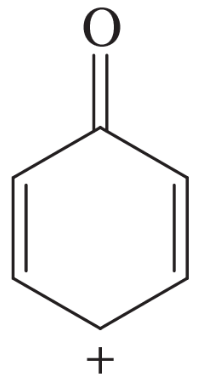
Some of the following compounds show aromatic properties, and others do not.
1. Predict which ones are likely to be aromatic, and explain why they are aromatic.
2. Predict which nitrogen atoms are more basic than water and which are less basic.
(d)

Guida verificata passo dopo passo
1
Step 1: Analyze the structure provided in the image. The compound is a six-membered ring with alternating double bonds (a conjugated system), a ketone group attached to the ring, and a positive charge on the ring. This structure suggests it may exhibit aromatic properties.
Step 2: Apply Huckel's rule for aromaticity. Huckel's rule states that a compound is aromatic if it has a planar, cyclic conjugated system with (4n + 2) π-electrons, where n is an integer. Count the π-electrons in the conjugated system of the ring.
Step 3: Consider the effect of the positive charge on the ring. The positive charge reduces the number of π-electrons in the conjugated system. Determine whether the total number of π-electrons satisfies Huckel's rule.
Step 4: Evaluate the basicity of nitrogen atoms (if present). Since the provided structure does not contain nitrogen atoms, this part of the question does not apply to the given compound. If nitrogen atoms were present, their basicity would depend on factors such as lone pair availability and resonance effects.
Step 5: Conclude whether the compound is aromatic based on the π-electron count and Huckel's rule. Additionally, confirm that the structure is planar and conjugated, which are necessary conditions for aromaticity.

Risposta video verificata per un problema simile:

Questa soluzione video è stata consigliata dai nostri tutor come utile per risolvere questo problema.
Durata del video:
5m

Concetti chiave

Ecco i concetti essenziali che devi comprendere per rispondere correttamente alla domanda.

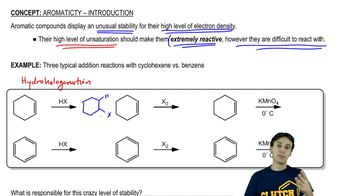
Aromaticity

Aromaticity refers to the special stability and unique properties of cyclic compounds that have a planar structure, a fully conjugated pi-electron system, and follow Hückel's rule (4n + 2 pi electrons). Compounds that are aromatic exhibit resonance, which lowers their energy and increases stability. Identifying aromatic compounds involves checking for these criteria, which can help predict their reactivity and interactions.
Video consigliato:
08:19
Intro to Aromaticity

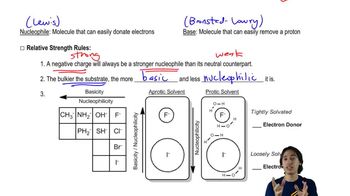
Basicity of Nitrogen

The basicity of nitrogen atoms in organic compounds is influenced by their hybridization and the presence of electron-withdrawing or electron-donating groups. Basicity is often compared to water, where nitrogen atoms with lone pairs that are more available for protonation are considered more basic. In aromatic systems, the nitrogen's involvement in the aromatic ring can affect its basicity, making it less available for bonding with protons.
Video consigliato:
06:21
Understanding the difference between basicity and nucleophilicity.

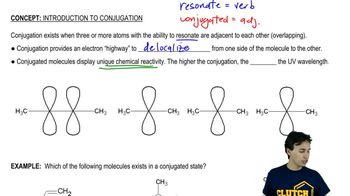
Conjugation and Resonance

Conjugation occurs when p-orbitals overlap across adjacent bonds, allowing for delocalization of electrons. This delocalization leads to resonance, where multiple structures can represent the same molecule, contributing to its stability. In the context of aromatic compounds, resonance structures help explain the equal bond lengths and the overall stability of the molecule, which is crucial for understanding both aromaticity and basicity.
Video consigliato:
05:29
Definition of Conjugation
Pratica correlata
Domanda del libro di testo

Each of the following heterocycles includes one or more nitrogen atoms. Classify each nitrogen atom as strongly basic or weakly basic, according to the availability of its lone pair of electrons.

(d)

(e)

1420
views

Domanda del libro di testo

Some of the following compounds show aromatic properties, and others do not.

1. Predict which ones are likely to be aromatic, and explain why they are aromatic.

2. Predict which nitrogen atoms are more basic than water and which are less basic.

(m)

465
views
Domanda del libro di testo

Some of the following compounds show aromatic properties, and others do not.

1. Predict which ones are likely to be aromatic, and explain why they are aromatic.

2. Predict which nitrogen atoms are more basic than water and which are less basic.

(e)

484
views
Domanda del libro di testo

Some of the following compounds show aromatic properties, and others do not.

1. Predict which ones are likely to be aromatic, and explain why they are aromatic.

(a)

(b)

(c)

1267
views
Domanda del libro di testo

Each of the following heterocycles includes one or more nitrogen atoms. Classify each nitrogen atom as strongly basic or weakly basic, according to the availability of its lone pair of electrons.

(a)

(b)

(c)

1425
views
Domanda del libro di testo

Some of the following compounds show aromatic properties, and others do not.

1. Predict which ones are likely to be aromatic, and explain why they are aromatic.

2. Predict which nitrogen atoms are more basic than water and which are less basic.

(f)

503
views