Ch. 16 - Aromatic Compounds
Wade - Organic Chemistry 9th Edition
Wade9th EditionOrganic ChemistryISBN: 9780135213728Non è quello che usi tu?Cambia libro di testo
Capitolo 16, Problema 2c

Using the information in Figure 16-2, calculate the values of ∆H° for the following reactions:
(c) Chemical reaction diagram showing benzene reacting with hydrogen in the presence of a catalyst to form cyclohexane.

Guida verificata passo dopo passo
1
Step 1: Identify the reaction type. The given reaction is a hydrogenation reaction where one double bond in cyclohexene is reduced to form cyclohexane using hydrogen gas and a catalyst.
Step 2: Understand the enthalpy change (∆H°) for hydrogenation reactions. Hydrogenation reactions typically release energy, and the enthalpy change is negative. The value of ∆H° for hydrogenation of one double bond can be found in Figure 16-2 or similar reference data.
Step 3: Locate the ∆H° value for the hydrogenation of a single double bond in the reference figure. This value is specific to the reaction of converting cyclohexene to cyclohexane.
Step 4: Write the balanced chemical equation for the reaction: C6H10+H2→C6H12. This equation represents the addition of hydrogen to cyclohexene.
Step 5: Use the ∆H° value from the reference figure to calculate the enthalpy change for the reaction. Ensure the units are consistent (e.g., kJ/mol) and interpret the negative sign as energy released during the reaction.

Risposta video verificata per un problema simile:

Questa soluzione video è stata consigliata dai nostri tutor come utile per risolvere questo problema.
Durata del video:
4m

Concetti chiave

Ecco i concetti essenziali che devi comprendere per rispondere correttamente alla domanda.

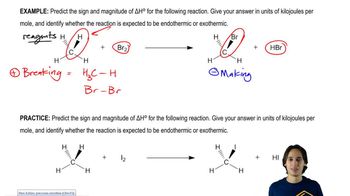
Enthalpy Change (∆H°)

Enthalpy change (∆H°) is a measure of the heat content of a system at constant pressure. It indicates whether a reaction is exothermic (releases heat, ∆H° < 0) or endothermic (absorbs heat, ∆H° > 0). Calculating ∆H° for a reaction involves using standard enthalpies of formation for the reactants and products, allowing chemists to predict energy changes during chemical transformations.
Video consigliato:
04:38
Calculating Enthalpies

Catalysis

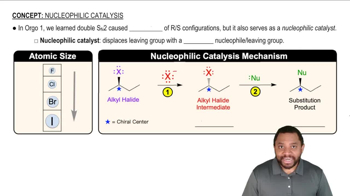
Catalysis refers to the process of increasing the rate of a chemical reaction by adding a substance known as a catalyst. In the reaction shown, a catalyst facilitates the hydrogenation of benzene to cyclohexane, lowering the activation energy required for the reaction to proceed. Catalysts are not consumed in the reaction, allowing them to be used repeatedly in multiple reaction cycles.
Video consigliato:
Percorso guidato
2:31
Nucleophilic Catalysis Concept 1

Hydrogenation

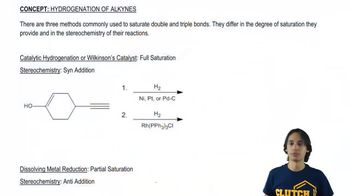
Hydrogenation is a chemical reaction that involves the addition of hydrogen (H₂) to an unsaturated compound, such as an alkene or an aromatic compound. In this case, benzene, an aromatic compound, reacts with hydrogen in the presence of a catalyst to form cyclohexane, a saturated compound. This process is significant in organic chemistry for converting unsaturated hydrocarbons into more stable saturated forms.
Video consigliato:
00:48
The definition of hydrogenation.