Ch. 17 - Reactions of Aromatic Compounds
Wade - Organic Chemistry 9th Edition
Wade9th EditionOrganic ChemistryISBN: 9780135213728Non è quello che usi tu?Cambia libro di testo
Capitolo 17, Problema 55c

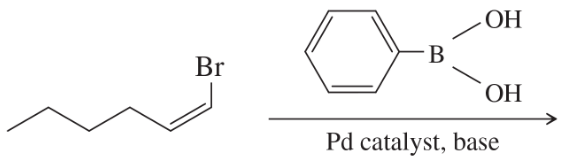
What products would you expect from the following coupling reactions?
(c)

Guida verificata passo dopo passo
1
Step 1: Recognize the reaction type. This is a Suzuki coupling reaction, which involves the reaction of an organoboron compound (here, a phenylboronic acid derivative) with an organohalide (here, an allyl bromide) in the presence of a palladium catalyst and a base.
Step 2: Identify the components. The phenylboronic acid derivative provides the aryl group, while the allyl bromide provides the allyl group. The palladium catalyst facilitates the formation of a new carbon-carbon bond between these two groups.
Step 3: Understand the mechanism. The reaction proceeds through oxidative addition of the allyl bromide to the palladium catalyst, transmetalation with the phenylboronic acid derivative, and reductive elimination to form the coupled product.
Step 4: Predict the product. The new bond forms between the carbon atom of the phenyl group (from the boronic acid) and the carbon atom of the allyl group (from the allyl bromide). The product will be an aryl-allyl compound.
Step 5: Verify the structure. The final product will have the phenyl group directly bonded to the allyl group, maintaining the double bond in the allyl group and the methyl substituent on the allyl chain.

Risposta video verificata per un problema simile:

Questa soluzione video è stata consigliata dai nostri tutor come utile per risolvere questo problema.
Durata del video:
4m

Concetti chiave

Ecco i concetti essenziali che devi comprendere per rispondere correttamente alla domanda.

Suzuki Coupling Reaction

The Suzuki coupling reaction is a widely used method in organic chemistry for forming carbon-carbon bonds. It involves the reaction of a boronic acid with an organic halide in the presence of a palladium catalyst and a base. This reaction is particularly valuable for synthesizing biaryl compounds and other complex organic molecules.

Palladium Catalysis

Palladium catalysis is crucial in many cross-coupling reactions, including the Suzuki reaction. Palladium serves as a catalyst that facilitates the oxidative addition of the organic halide and the subsequent transmetalation with the boronic acid. The ability of palladium to cycle between different oxidation states allows it to effectively promote these reactions.

Base in Coupling Reactions

In coupling reactions like the Suzuki reaction, a base is essential for deprotonating the boronic acid, generating a more reactive boronate species. The base also helps to neutralize the acidic byproducts formed during the reaction. Common bases used include sodium hydroxide or potassium carbonate, which enhance the efficiency of the coupling process.