Ch. 17 - Reactions of Aromatic Compounds
Wade - Organic Chemistry 9th Edition
Wade9th EditionOrganic ChemistryISBN: 9780135213728Non è quello che usi tu?Cambia libro di testo
Capitolo 17, Problema 55b

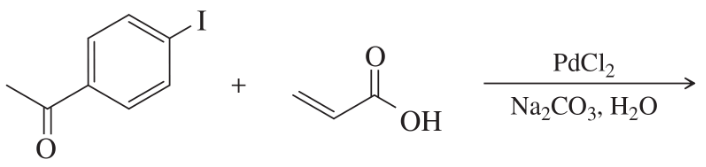
What products would you expect from the following coupling reactions?
(b)

Guida verificata passo dopo passo
1
Step 1: Identify the type of coupling reaction. The reaction involves a palladium catalyst (PdCl₂), which suggests it is a Heck reaction. The Heck reaction typically couples an aryl halide (such as an aryl iodide) with an alkene or an unsaturated compound.
Step 2: Analyze the reactants. The aryl iodide has an iodine atom attached to a benzene ring with a ketone group at the para position. The second reactant is acrylic acid, which contains a double bond and a carboxylic acid functional group.
Step 3: Determine the regioselectivity of the Heck reaction. The palladium catalyst facilitates the coupling of the aryl group to the double bond of acrylic acid. The aryl group will attach to the less substituted carbon of the double bond, following the typical regioselectivity of the Heck reaction.
Step 4: Predict the product structure. The aryl group from the aryl iodide will bond to the terminal carbon of the double bond in acrylic acid, forming a new C-C bond. The double bond in acrylic acid will shift to form a conjugated system with the benzene ring.
Step 5: Verify the stereochemistry. The Heck reaction generally produces the trans product due to the anti addition mechanism. Ensure the product reflects this stereochemical outcome.

Risposta video verificata per un problema simile:

Questa soluzione video è stata consigliata dai nostri tutor come utile per risolvere questo problema.
Durata del video:
2m

Concetti chiave

Ecco i concetti essenziali che devi comprendere per rispondere correttamente alla domanda.

Cross-Coupling Reactions

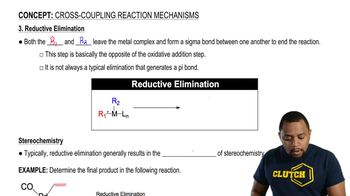
Cross-coupling reactions are a class of reactions in organic chemistry where two different organic groups are joined together using a metal catalyst. These reactions often involve the formation of carbon-carbon bonds and are crucial for synthesizing complex organic molecules. Common examples include the Suzuki and Heck reactions, which utilize palladium as a catalyst to facilitate the coupling of aryl halides with various nucleophiles.
Video consigliato:
03:22
Cross-Coupling Reaction Mechanisms

Palladium Catalysis

Palladium catalysis is a key technique in organic synthesis, particularly in cross-coupling reactions. Palladium serves as a versatile catalyst that can activate both the organic halide and the nucleophile, allowing for efficient bond formation. The use of palladium complexes, such as PdCl2, enables the reaction to proceed under milder conditions and with greater selectivity, making it a valuable tool in the synthesis of pharmaceuticals and other complex molecules.
Video consigliato:
Percorso guidato
2:31
Nucleophilic Catalysis Concept 1

Electrophilic Aromatic Substitution

Electrophilic aromatic substitution (EAS) is a fundamental reaction mechanism in organic chemistry where an electrophile replaces a hydrogen atom on an aromatic ring. This process is essential for modifying aromatic compounds and can lead to the formation of various functional groups. In the context of the provided reaction, the presence of an iodine substituent on the aromatic ring enhances its reactivity, facilitating the coupling with the nucleophile through the EAS mechanism.
Video consigliato:
03:07
EAS Review