Ch. 18 - Ketones and Aldehydes
Wade - Organic Chemistry 9th Edition
Wade9th EditionOrganic ChemistryISBN: 9780135213728Non è quello che usi tu?Cambia libro di testo
Capitolo 18, Problema 72

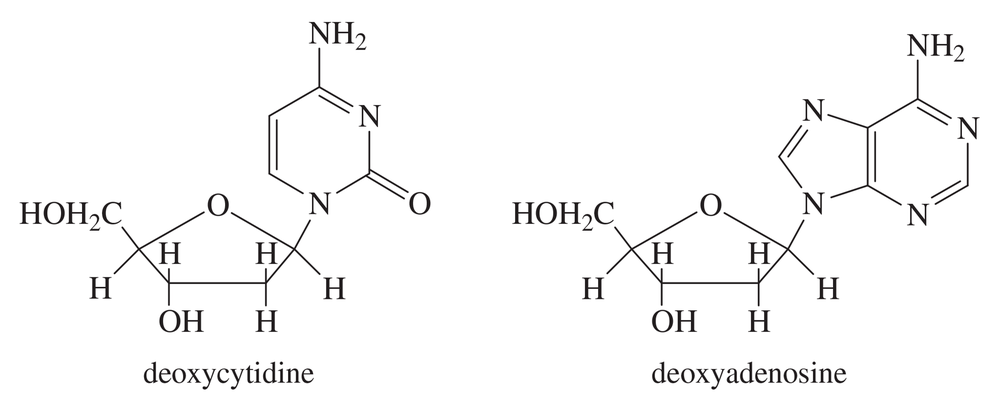
The nucleosides that make up DNA have heterocyclic rings linked to deoxyribose by an aminoacetal functional group. Point out the aminoacetal linkages in deoxycytidine and deoxyadenosine.

Guida verificata passo dopo passo
1
Step 1: Understand the structure of nucleosides. Nucleosides consist of a nitrogenous base (heterocyclic ring) linked to a sugar molecule (deoxyribose in DNA) via a glycosidic bond. In this case, the bond is an aminoacetal linkage.
Step 2: Identify the nitrogenous bases in deoxycytidine and deoxyadenosine. Deoxycytidine contains cytosine as its base, while deoxyadenosine contains adenine as its base. These bases are heterocyclic rings.
Step 3: Locate the deoxyribose sugar in the structures. The sugar is a five-membered ring with hydroxyl groups and a hydrogen atom replacing the hydroxyl group at the 2' position, characteristic of deoxyribose.
Step 4: Examine the bond between the nitrogenous base and the sugar. The aminoacetal linkage is formed between the nitrogen atom of the base and the anomeric carbon of the sugar. This bond is a glycosidic bond, specifically an N-glycosidic bond.
Step 5: In the provided structures, identify the aminoacetal linkage. For deoxyadenosine, the bond between the nitrogen atom in adenine and the anomeric carbon of deoxyribose is the aminoacetal linkage. Similarly, for deoxycytidine, the bond between the nitrogen atom in cytosine and the anomeric carbon of deoxyribose is the aminoacetal linkage.

Risposta video verificata per un problema simile:

Questa soluzione video è stata consigliata dai nostri tutor come utile per risolvere questo problema.
Durata del video:
2m

Concetti chiave

Ecco i concetti essenziali che devi comprendere per rispondere correttamente alla domanda.

Nucleosides

Nucleosides are organic molecules composed of a nitrogenous base linked to a sugar molecule, specifically ribose or deoxyribose. In DNA, nucleosides consist of a deoxyribose sugar attached to one of four nitrogenous bases: adenine, cytosine, guanine, or thymine. Understanding the structure of nucleosides is crucial for recognizing how they form the building blocks of DNA.
Video consigliato:
Percorso guidato
1:21
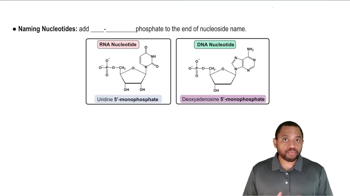
Naming Nucleosides and Nucleotides Concept 2

Aminoacetal Functional Group

An aminoacetal functional group is formed when an amine group is attached to a carbon atom that is also bonded to an ether or acetal group. In the context of nucleosides, this linkage connects the nitrogenous base to the sugar, facilitating the formation of nucleotides. Identifying this linkage is essential for understanding the structural integrity and function of nucleic acids.
Video consigliato:
02:36
Identifying Functional Groups

Chemical Structure of Deoxycytidine and Deoxyadenosine

Deoxycytidine and deoxyadenosine are specific nucleosides that contain the nitrogenous bases cytosine and adenine, respectively, linked to deoxyribose. Analyzing their chemical structures reveals the aminoacetal linkages that connect the bases to the sugar. Recognizing these structures is vital for understanding how nucleosides contribute to the overall architecture of DNA.
Video consigliato:
Percorso guidato
3:11
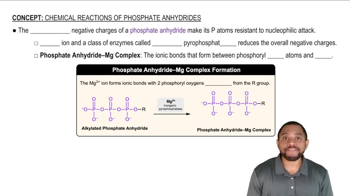
Chemical Reactions of Phosphate Anhydrides Concept 1