Ch. 18 - Ketones and Aldehydes
Wade - Organic Chemistry 9th Edition
Wade9th EditionOrganic ChemistryISBN: 9780135213728Non è quello che usi tu?Cambia libro di testo
Capitolo 18, Problema 70

Show a complete mechanism for this reaction.

Guida verificata passo dopo passo
1
Step 1: Protonation of the carbonyl group - The reaction begins with the protonation of the oxygen atom in the carbonyl group of the ketone by HCl. This increases the electrophilicity of the carbonyl carbon, making it more susceptible to nucleophilic attack.
Step 2: Nucleophilic attack by the amine - The lone pair of electrons on the nitrogen atom of the amine attacks the electrophilic carbonyl carbon, forming a tetrahedral intermediate. This step involves the formation of a bond between the nitrogen and the carbonyl carbon.
Step 3: Proton transfer - A proton transfer occurs within the intermediate to stabilize the structure. The hydroxyl group formed from the carbonyl oxygen is protonated, making it a good leaving group.
Step 4: Formation of the iminium ion - The hydroxyl group leaves as water, resulting in the formation of an iminium ion. This intermediate is stabilized by resonance.
Step 5: Nucleophilic attack by methanol - Methanol attacks the iminium ion, forming a bond between the oxygen atom of methanol and the carbon atom of the iminium ion. This leads to the formation of the final product, a cyclic aminal, and water as a byproduct.

Risposta video verificata per un problema simile:

Questa soluzione video è stata consigliata dai nostri tutor come utile per risolvere questo problema.
Durata del video:
10m

Concetti chiave

Ecco i concetti essenziali che devi comprendere per rispondere correttamente alla domanda.

Reaction Mechanism

A reaction mechanism is a step-by-step description of how a chemical reaction occurs at the molecular level. It outlines the sequence of elementary steps, including bond breaking and formation, and the intermediates formed during the reaction. Understanding the mechanism is crucial for predicting the products and the conditions under which the reaction occurs.
Video consigliato:
02:16
Heck Reaction Mechanism

Nucleophiles and Electrophiles

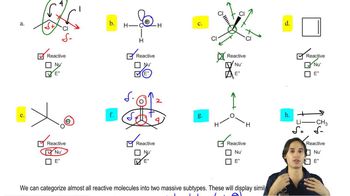
Nucleophiles are species that donate an electron pair to form a chemical bond, while electrophiles are electron-deficient species that accept an electron pair. Identifying these roles in a reaction is essential for understanding how reactants interact and transform into products. This concept is fundamental in organic chemistry, particularly in substitution and addition reactions.
Video consigliato:
03:
Nucleophile or Electrophile

Catalysis

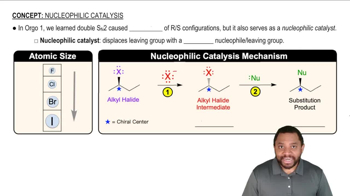
Catalysis refers to the process of increasing the rate of a chemical reaction by adding a substance called a catalyst, which is not consumed in the reaction. Catalysts work by providing an alternative pathway with a lower activation energy. Understanding the role of catalysts is important for optimizing reaction conditions and improving yields in organic synthesis.
Video consigliato:
Percorso guidato
2:31
Nucleophilic Catalysis Concept 1