Ch. 18 - Ketones and Aldehydes
Wade - Organic Chemistry 9th Edition
Wade9th EditionOrganic ChemistryISBN: 9780135213728Non è quello che usi tu?Cambia libro di testo
Capitolo 18, Problema 64e

Hydration of alkynes (via oxymercuration) gives good yields of single compounds only with symmetrical or terminal alkynes. Show what the products would be from hydration of each compound.
e. 3-methylcyclodecyne

Guida verificata passo dopo passo
1
Step 1: Understand the reaction mechanism. Hydration of alkynes via oxymercuration involves the addition of water (H₂O) across the triple bond in the presence of mercuric sulfate (HgSO₄) and sulfuric acid (H₂SO₄). This reaction typically follows Markovnikov's rule, where the hydroxyl group (-OH) adds to the more substituted carbon of the triple bond.
Step 2: Analyze the structure of the given alkyne, 3-methylcyclodecyne. This compound contains a cyclodecane ring with a triple bond between carbons 3 and 4, and a methyl group attached to carbon 3. The triple bond is internal, meaning it is not terminal or symmetrical.
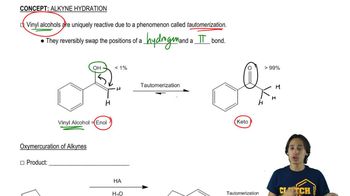
Step 3: Predict the intermediate formed during the reaction. The hydration of the alkyne will first produce an enol intermediate (a compound with a hydroxyl group attached to a carbon-carbon double bond). The enol is unstable and will tautomerize to form a ketone. The tautomerization occurs because the ketone form is more thermodynamically stable.
Step 4: Apply Markovnikov's rule to determine the position of the hydroxyl group in the enol intermediate. Since the hydroxyl group adds to the more substituted carbon, it will attach to carbon 4 (the carbon adjacent to the methyl group). This leads to the formation of an enol with the double bond between carbons 3 and 4.
Step 5: Identify the final product after tautomerization. The enol will rearrange to form a ketone. The double bond will shift, and the oxygen from the hydroxyl group will form a carbonyl group (C=O) on carbon 4. The final product is 4-methylcyclodecanone, a ketone with the carbonyl group on carbon 4 and a methyl group on carbon 3.

Risposta video verificata per un problema simile:

Questa soluzione video è stata consigliata dai nostri tutor come utile per risolvere questo problema.
Durata del video:
5m

Concetti chiave

Ecco i concetti essenziali che devi comprendere per rispondere correttamente alla domanda.

Hydration of Alkynes

Hydration of alkynes involves the addition of water (H2O) across the triple bond of an alkyne, typically in the presence of an acid catalyst. This reaction can lead to the formation of enols, which can subsequently tautomerize to form ketones or aldehydes. The regioselectivity of the reaction is influenced by the structure of the alkyne, particularly whether it is symmetrical or terminal.
Video consigliato:
09:11
Alkyne Hydration

Oxymercuration-Demercuration

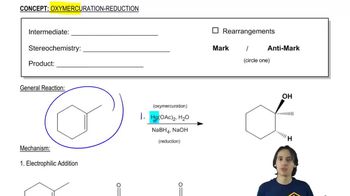
Oxymercuration-demercuration is a two-step reaction used to hydrate alkenes and alkynes. In the first step, mercuric acetate reacts with the alkyne to form a mercurial intermediate, which is then treated with water to yield an alcohol. The second step involves the removal of the mercury group, typically using sodium borohydride, resulting in the formation of the final alcohol product.
Video consigliato:
05:
General properties of oxymercuration-reduction.

Symmetrical vs. Terminal Alkynes

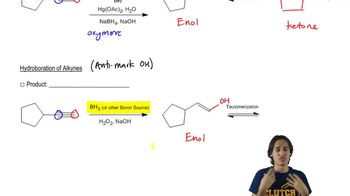
Symmetrical alkynes have identical substituents on both ends of the triple bond, leading to a single product upon hydration. In contrast, terminal alkynes have a hydrogen atom at one end, allowing for the formation of different products depending on the regioselectivity of the reaction. Understanding the structure of the alkyne is crucial for predicting the outcome of the hydration reaction.
Video consigliato:
02:43
Anti-Markovnikov addition of alcohols to terminal alkynes yields aldehydes