Ch. 18 - Ketones and Aldehydes
Wade - Organic Chemistry 9th Edition
Wade9th EditionOrganic ChemistryISBN: 9780135213728Non è quello che usi tu?Cambia libro di testo
Capitolo 18, Problema 53g

Predict the products formed when cyclohexanone reacts with the following reagents.
g. Tollens reagent

Guida verificata passo dopo passo
1
Step 1: Recognize the functional group in cyclohexanone. Cyclohexanone is a ketone, characterized by a carbonyl group (C=O) bonded to two alkyl groups.
Step 2: Understand the nature of Tollens reagent. Tollens reagent is an aqueous solution of silver nitrate (AgNO₃) and ammonia (NH₃), which is used to test for aldehydes. It oxidizes aldehydes to carboxylic acids and reduces Ag⁺ ions to metallic silver (Ag).
Step 3: Determine the reactivity of ketones with Tollens reagent. Ketones, unlike aldehydes, generally do not react with Tollens reagent because they cannot be oxidized under these conditions. The carbonyl group in ketones is less reactive toward oxidation due to the absence of a hydrogen atom directly bonded to the carbonyl carbon.
Step 4: Predict the outcome of the reaction. Since cyclohexanone is a ketone, it will not react with Tollens reagent, and no oxidation or reduction will occur. The solution will remain unchanged, and no silver mirror will form.
Step 5: Summarize the result. Cyclohexanone does not produce any products when treated with Tollens reagent because ketones are resistant to oxidation by this reagent.

Risposta video verificata per un problema simile:

Questa soluzione video è stata consigliata dai nostri tutor come utile per risolvere questo problema.
Durata del video:
1m

Concetti chiave

Ecco i concetti essenziali che devi comprendere per rispondere correttamente alla domanda.

Tollens' Reagent

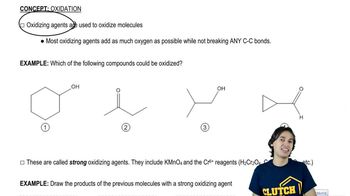
Tollens' reagent is a solution of silver nitrate in ammonia, commonly used to test for aldehydes. It contains the complex ion [Ag(NH3)2]+, which oxidizes aldehydes to carboxylic acids while reducing silver ions to metallic silver. In the case of cyclohexanone, which is a ketone, it does not react with Tollens' reagent, as ketones are generally not oxidized by this reagent.
Video consigliato:
01:52
Reagents

Oxidation-Reduction Reactions

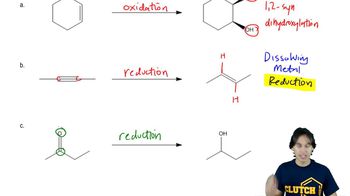
Oxidation-reduction (redox) reactions involve the transfer of electrons between substances, leading to changes in oxidation states. In organic chemistry, oxidation often refers to the addition of oxygen or the removal of hydrogen, while reduction is the opposite. Understanding these concepts is crucial for predicting the outcomes of reactions involving reagents like Tollens' reagent, which specifically oxidizes aldehydes but not ketones.
Video consigliato:
00:54
Distinguishing between Oxidation and Reduction

Reactivity of Ketones vs. Aldehydes

Ketones and aldehydes are both carbonyl compounds, but they differ in reactivity due to their structural features. Aldehydes have at least one hydrogen atom attached to the carbonyl carbon, making them more susceptible to oxidation. In contrast, ketones, such as cyclohexanone, have two alkyl groups attached to the carbonyl carbon, which makes them less reactive towards oxidizing agents like Tollens' reagent.
Video consigliato:
03:57
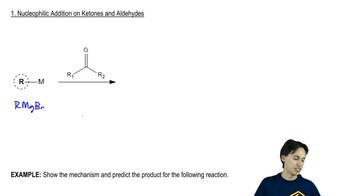
Nucleophilic Addition on Ketones and Aldehydes