Ch. 18 - Ketones and Aldehydes
Wade - Organic Chemistry 9th Edition
Wade9th EditionOrganic ChemistryISBN: 9780135213728Non è quello che usi tu?Cambia libro di testo
Capitolo 18, Problema 53f

Predict the products formed when cyclohexanone reacts with the following reagents.
(f) PhMgBr and then mild H3O+

Guida verificata passo dopo passo
1
Step 1: Recognize the type of reaction. Cyclohexanone is a ketone, and PhMgBr is a Grignard reagent. Grignard reagents are nucleophiles that react with carbonyl compounds to form alcohols after hydrolysis.
Step 2: Identify the electrophilic site in cyclohexanone. The carbonyl carbon in cyclohexanone is electrophilic due to the partial positive charge caused by the oxygen atom's electronegativity.
Step 3: Describe the nucleophilic attack. The phenyl group (Ph) from PhMgBr will attack the carbonyl carbon, breaking the π bond of the C=O group and forming a tetrahedral intermediate. This intermediate contains an alkoxide ion (R-O⁻).
Step 4: Explain the role of mild H3O+. The alkoxide ion formed in the previous step is protonated by mild H3O+ (acidic workup), resulting in the formation of a secondary alcohol.
Step 5: Predict the final product. The reaction yields a secondary alcohol where the phenyl group (Ph) is attached to the carbon that was originally part of the carbonyl group in cyclohexanone.

Risposta video verificata per un problema simile:

Questa soluzione video è stata consigliata dai nostri tutor come utile per risolvere questo problema.
Durata del video:
3m

Concetti chiave

Ecco i concetti essenziali che devi comprendere per rispondere correttamente alla domanda.

Grignard Reagents

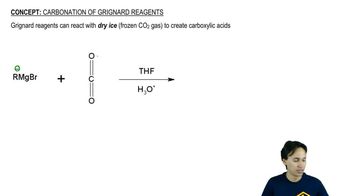
Grignard reagents, such as PhMgBr, are organomagnesium compounds that act as nucleophiles in organic reactions. They readily react with electrophiles, such as carbonyl compounds, to form alcohols. In this case, PhMgBr will attack the carbonyl carbon of cyclohexanone, leading to the formation of a magnesium alkoxide intermediate.
Video consigliato:
02:12
Carbonation of Grignard Reagents

Nucleophilic Addition

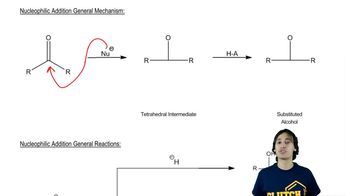
Nucleophilic addition is a fundamental reaction mechanism in organic chemistry where a nucleophile attacks an electrophilic center, typically a carbonyl carbon. In the reaction of cyclohexanone with PhMgBr, the nucleophile (PhMgBr) adds to the electrophilic carbon of the carbonyl group, resulting in the formation of a new carbon-carbon bond and an alkoxide intermediate.
Video consigliato:
08:27
Nucleophilic Addition

Acid Workup

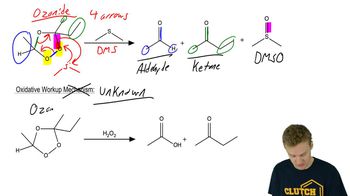
An acid workup, often involving mild H3O+, is a crucial step following nucleophilic addition reactions. It serves to protonate the alkoxide intermediate formed after the Grignard reaction, converting it into a stable alcohol. This step is essential for isolating the final product, which in this case will be a phenyl-substituted alcohol derived from cyclohexanone.
Video consigliato:
01:31
Oxidative Workup Mechanism: