Ch. 18 - Ketones and Aldehydes
Wade - Organic Chemistry 9th Edition
Wade9th EditionOrganic ChemistryISBN: 9780135213728Non è quello che usi tu?Cambia libro di testo
Capitolo 18, Problema 20a

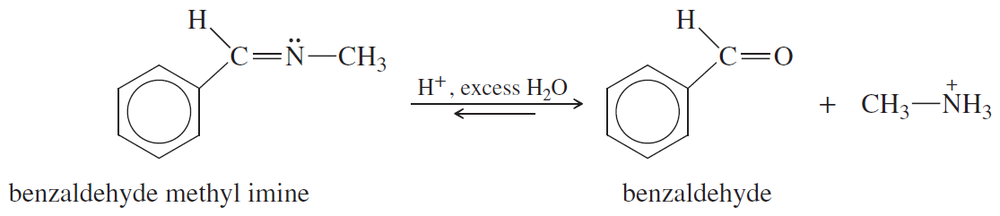
Propose a mechanism for the hydrolysis of benzaldehyde methyl imine just shown.

Guida verificata passo dopo passo
1
Step 1: Protonation of the imine nitrogen. The reaction begins with the addition of H3O+ (acidic conditions), which protonates the nitrogen atom of the imine group. This increases the electrophilicity of the carbon atom attached to the nitrogen.
Step 2: Nucleophilic attack by water. A water molecule acts as a nucleophile and attacks the electrophilic carbon atom of the imine group, forming a tetrahedral intermediate.
Step 3: Proton transfer. A proton transfer occurs within the intermediate to stabilize the structure, leading to the formation of a hydroxyl group (-OH) and a positively charged nitrogen group.
Step 4: Cleavage of the C-N bond. The positively charged nitrogen group is eliminated as CH3NH2 (methylamine), leaving behind a carbonyl group (-C=O) on the benzaldehyde structure.
Step 5: Deprotonation. The hydroxyl group is deprotonated to regenerate the neutral carbonyl compound, resulting in the final products: benzaldehyde and methylamine.

Risposta video verificata per un problema simile:

Questa soluzione video è stata consigliata dai nostri tutor come utile per risolvere questo problema.
Durata del video:
7m

Concetti chiave

Ecco i concetti essenziali che devi comprendere per rispondere correttamente alla domanda.

Imine Hydrolysis

Imine hydrolysis is a chemical reaction where an imine reacts with water, often in the presence of an acid or base, to form a carbonyl compound and an amine. In this case, benzaldehyde methyl imine undergoes hydrolysis to yield benzaldehyde and methylamine. Understanding this process is crucial for predicting the products and mechanism of the reaction.
Video consigliato:
06:23
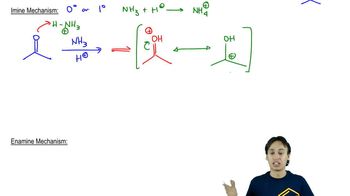
Imine Mechanism

Acid-Base Catalysis

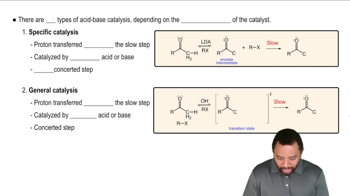
Acid-base catalysis involves the use of an acid or base to accelerate a chemical reaction. In the hydrolysis of imines, hydronium ions (H3O+) act as a catalyst, facilitating the protonation of the imine nitrogen, which enhances the electrophilicity of the carbon atom. This step is essential for the subsequent nucleophilic attack by water.
Video consigliato:
Percorso guidato
2:50
Acid-Base Catalysis Concept 3

Nucleophilic Attack

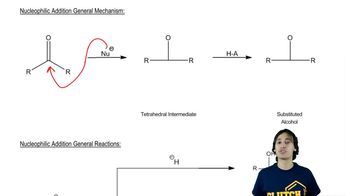
Nucleophilic attack is a fundamental concept in organic chemistry where a nucleophile, a species with a pair of electrons, attacks an electrophile, a positively charged or electron-deficient species. In the hydrolysis of benzaldehyde methyl imine, water acts as the nucleophile that attacks the carbon atom of the imine, leading to the formation of the carbonyl compound and the release of the amine.
Video consigliato:
08:27
Nucleophilic Addition