Ch. 18 - Ketones and Aldehydes
Wade - Organic Chemistry 9th Edition
Wade9th EditionOrganic ChemistryISBN: 9780135213728Non è quello che usi tu?Cambia libro di testo
Capitolo 18, Problema 11a

Show how you would accomplish the following synthetic conversions. You may use any additional reagents and solvents you need.
(a) Schematic showing the conversion of benzaldehyde to a ketone with phenyl groups on both sides.

Guida verificata passo dopo passo
1
Step 1: Identify the starting material and the target product. The starting material is benzaldehyde (Ph-CHO), and the target product is benzophenone (Ph-C(O)-Ph). This transformation involves converting an aldehyde into a ketone.
Step 2: Recognize the type of reaction required. To achieve this transformation, you need to add a phenyl group (Ph) to the carbonyl carbon of benzaldehyde. This can be accomplished using a nucleophilic addition reaction followed by oxidation.
Step 3: Select appropriate reagents for the nucleophilic addition step. A Grignard reagent, such as phenylmagnesium bromide (Ph-MgBr), can be used to add the phenyl group to the carbonyl carbon. The reaction proceeds via the formation of a tetrahedral intermediate.
Step 4: After the addition of the Grignard reagent, the intermediate formed is an alcohol (Ph-C(OH)-Ph). To convert this alcohol into the ketone, an oxidation step is required. Suitable oxidizing agents include PCC (pyridinium chlorochromate) or Jones reagent (CrO3/H2SO4).
Step 5: Combine the steps. First, react benzaldehyde with phenylmagnesium bromide in an appropriate solvent like diethyl ether to form the alcohol intermediate. Then, oxidize the intermediate using PCC or another oxidizing agent to yield benzophenone.

Risposta video verificata per un problema simile:

Questa soluzione video è stata consigliata dai nostri tutor come utile per risolvere questo problema.
Durata del video:
2m

Concetti chiave

Ecco i concetti essenziali che devi comprendere per rispondere correttamente alla domanda.

Benzaldehyde

Benzaldehyde (Ph-CHO) is an aromatic aldehyde characterized by the presence of a formyl group (-CHO) attached to a phenyl group (Ph). It serves as a key starting material in organic synthesis due to its reactivity, particularly in nucleophilic addition reactions. Understanding its structure and reactivity is essential for converting it into other functional groups, such as ketones.
Video consigliato:
Percorso guidato
0:58
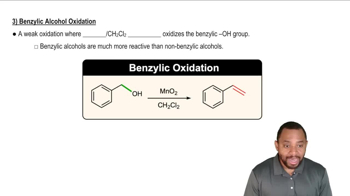
Reactions at Benzylic Positions Concept 4

Aldol Condensation

Aldol condensation is a fundamental reaction in organic chemistry where aldehydes or ketones with alpha-hydrogens react to form β-hydroxy aldehydes or ketones. This reaction can lead to the formation of larger carbon skeletons and is crucial for synthesizing complex molecules. In the context of the conversion from benzaldehyde to a ketone, this reaction can facilitate the formation of the desired product through subsequent dehydration.
Video consigliato:
09:51
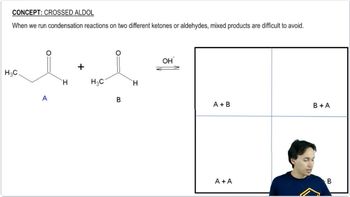
Crossed Aldol

Reagents and Solvents

The choice of reagents and solvents is critical in organic synthesis as they influence the reaction pathway, yield, and selectivity of the desired product. Common reagents for converting aldehydes to ketones include Grignard reagents or organolithium compounds, which can add to the carbonyl carbon. Understanding the role of these reagents and the appropriate conditions for the reaction is essential for successfully achieving the conversion depicted in the question.
Video consigliato:
01:16
Identification of polarity in solvents