Ch. 18 - Ketones and Aldehydes
Wade - Organic Chemistry 9th Edition
Wade9th EditionOrganic ChemistryISBN: 9780135213728Non è quello che usi tu?Cambia libro di testo
Capitolo 18, Problema 56f

Show how you would synthesize octanal from each compound. You may use any necessary reagents.
(f) octanoic acid

Guida verificata passo dopo passo
1
Step 1: Begin by understanding the transformation required. Octanoic acid (a carboxylic acid) needs to be converted into octanal (an aldehyde). This involves reducing the carboxylic acid to an aldehyde, which typically requires selective reduction methods.
Step 2: Use a reagent that can selectively reduce carboxylic acids to aldehydes without over-reducing them to alcohols. One common reagent for this purpose is diisobutylaluminum hydride (DIBAL-H). DIBAL-H is known for its ability to stop the reduction at the aldehyde stage.
Step 3: Add DIBAL-H to the octanoic acid under controlled conditions, typically at low temperatures (e.g., -78°C). This ensures that the reaction proceeds selectively to form octanal.
Step 4: After the reaction is complete, quench the reaction mixture with water or a mild acid to hydrolyze the intermediate and isolate the aldehyde product.
Step 5: Purify the resulting octanal using techniques such as distillation or extraction to ensure the product is free from impurities and unreacted starting materials.

Risposta video verificata per un problema simile:

Questa soluzione video è stata consigliata dai nostri tutor come utile per risolvere questo problema.
Durata del video:
5m

Concetti chiave

Ecco i concetti essenziali che devi comprendere per rispondere correttamente alla domanda.

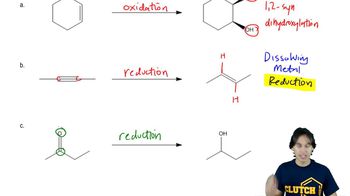
Oxidation-Reduction Reactions

Oxidation-reduction (redox) reactions are fundamental in organic chemistry, involving the transfer of electrons between substances. In the context of synthesizing octanal from octanoic acid, the oxidation of the alcohol functional group to an aldehyde is crucial. Understanding how to manipulate oxidation states allows chemists to convert carboxylic acids into aldehydes effectively.
Video consigliato:
00:54
Distinguishing between Oxidation and Reduction

Functional Group Interconversion

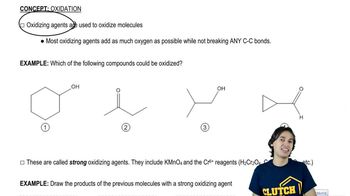
Functional group interconversion refers to the transformation of one functional group into another within a molecule. In this case, converting octanoic acid (a carboxylic acid) into octanal (an aldehyde) requires specific reagents that facilitate this change. Mastery of these transformations is essential for organic synthesis and designing pathways to desired products.
Video consigliato:
02:36
Identifying Functional Groups

Reagents and Reaction Conditions

The choice of reagents and reaction conditions is critical in organic synthesis. For the conversion of octanoic acid to octanal, reagents such as lithium aluminum hydride (LiAlH4) or pyridinium chlorochromate (PCC) can be employed to achieve selective oxidation. Understanding how different reagents affect reaction outcomes is vital for successful synthesis in organic chemistry.
Video consigliato:
01:52
Reagents