Ch. 18 - Ketones and Aldehydes
Wade - Organic Chemistry 9th Edition
Wade9th EditionOrganic ChemistryISBN: 9780135213728Non è quello che usi tu?Cambia libro di testo
Capitolo 18, Problema 56e

Show how you would synthesize octanal from each compound. You may use any necessary reagents.
(e) 1-bromohexane

Guida verificata passo dopo passo
1
Step 1: Begin by recognizing that octanal is an aldehyde with eight carbon atoms. To synthesize octanal from 1-bromohexane, you need to extend the carbon chain by two carbons and introduce the aldehyde functional group.
Step 2: Perform a nucleophilic substitution reaction to replace the bromine atom in 1-bromohexane with a cyanide group (-CN). Use sodium cyanide (NaCN) in an aprotic solvent like DMSO to form hexanenitrile (CH₃(CH₂)₄CH₂CN).
Step 3: Hydrolyze the nitrile group in hexanenitrile to convert it into a carboxylic acid. Use acidic hydrolysis (e.g., H₃O⁺ or dilute HCl) to produce heptanoic acid (CH₃(CH₂)₅COOH).
Step 4: Reduce the carboxylic acid group in heptanoic acid to an aldehyde. Use a reducing agent like diisobutylaluminum hydride (DIBAL-H) at low temperatures to selectively reduce the carboxylic acid to heptanal (CH₃(CH₂)₅CHO).
Step 5: Perform a Grignard reaction to extend the carbon chain by one carbon. React heptanal with ethylmagnesium bromide (CH₃CH₂MgBr) followed by acidic workup to form octanal (CH₃(CH₂)₆CHO).

Risposta video verificata per un problema simile:

Questa soluzione video è stata consigliata dai nostri tutor come utile per risolvere questo problema.
Durata del video:
8m

Concetti chiave

Ecco i concetti essenziali che devi comprendere per rispondere correttamente alla domanda.

Nucleophilic Substitution

Nucleophilic substitution is a fundamental reaction in organic chemistry where a nucleophile replaces a leaving group in a molecule. In the case of 1-bromohexane, the bromine atom acts as a leaving group, allowing a nucleophile, such as a hydride ion or an alkoxide, to attack the carbon atom bonded to the bromine. This reaction is crucial for forming new carbon-carbon bonds, which is essential in synthesizing octanal.
Video consigliato:
01:47
Nucleophiles and Electrophiles can react in Substitution Reactions.

Grignard Reagents

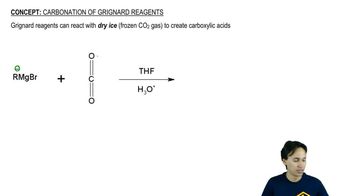
Grignard reagents are organomagnesium compounds that act as strong nucleophiles in organic synthesis. They are formed by reacting an alkyl or aryl halide with magnesium in dry ether. In synthesizing octanal from 1-bromohexane, a Grignard reagent can be created and then reacted with an appropriate carbonyl compound, such as an aldehyde or ketone, to form the desired product through nucleophilic addition.
Video consigliato:
02:12
Carbonation of Grignard Reagents

Oxidation of Alcohols

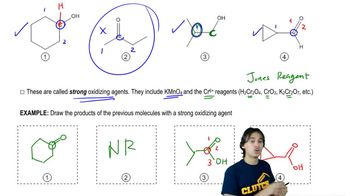
The oxidation of alcohols is a key transformation in organic chemistry where alcohols are converted into carbonyl compounds, such as aldehydes or ketones. This process can be achieved using various oxidizing agents, such as potassium dichromate or PCC (pyridinium chlorochromate). In the context of synthesizing octanal, an intermediate alcohol formed from 1-bromohexane can be oxidized to yield octanal, demonstrating the importance of oxidation reactions in organic synthesis.
Video consigliato:
05:53
Strong oxidizing agents