Ch. 19 - Amines
Wade - Organic Chemistry 9th Edition
Wade9th EditionOrganic ChemistryISBN: 9780135213728Non è quello che usi tu?Cambia libro di testo
Capitolo 19, Problema 39g

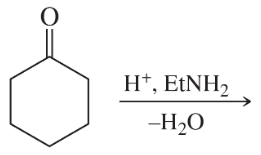
Predict the products of the following reactions:
(g)

Guida verificata passo dopo passo
1
Step 1: Identify the functional group in the starting material. In this case, the starting material is a cyclic ketone (cyclohexanone). The carbonyl group (C=O) is reactive and will undergo nucleophilic attack.
Step 2: Recognize the reagents provided. The reaction involves ethylamine (EtNH₂) in the presence of an acid catalyst (H⁺). This suggests an imine formation reaction, where the amine reacts with the ketone to form an imine, with water (H₂O) as a byproduct.
Step 3: Understand the mechanism. The reaction proceeds as follows: (a) Protonation of the carbonyl oxygen by H⁺ increases the electrophilicity of the carbonyl carbon. (b) Ethylamine (EtNH₂) acts as a nucleophile and attacks the carbonyl carbon, forming a tetrahedral intermediate. (c) The intermediate undergoes dehydration (-H₂O) to form the imine product.
Step 4: Predict the structure of the product. The imine product will have the ethyl group (CH₃CH₂-) attached to the nitrogen atom, and the double bond will form between the nitrogen and the carbon that was originally part of the carbonyl group.
Step 5: Verify the reaction conditions. Ensure that the reaction is carried out under acidic conditions to facilitate protonation and dehydration, which are essential for imine formation.

Risposta video verificata per un problema simile:

Questa soluzione video è stata consigliata dai nostri tutor come utile per risolvere questo problema.
Durata del video:
4m

Concetti chiave

Ecco i concetti essenziali che devi comprendere per rispondere correttamente alla domanda.

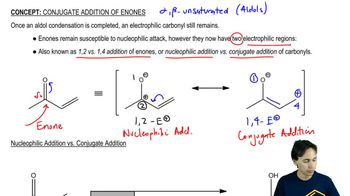
Electrophilic Addition

Electrophilic addition is a fundamental reaction mechanism in organic chemistry where an electrophile reacts with a nucleophile, leading to the formation of a more complex molecule. In this context, the carbonyl group (C=O) acts as an electrophile, attracting nucleophiles such as amines. Understanding this mechanism is crucial for predicting the products of reactions involving carbonyl compounds.
Video consigliato:
09:23
1,2 vs 1,4 Addition

Amine Nucleophiles

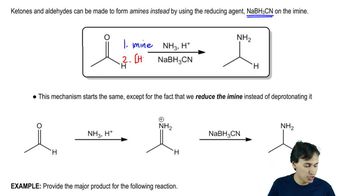
Amines are organic compounds derived from ammonia by replacing one or more hydrogen atoms with alkyl or aryl groups. In the given reaction, ethylamine (EtNH2) serves as a nucleophile that attacks the electrophilic carbon of the carbonyl group. Recognizing the role of amines in nucleophilic addition reactions is essential for predicting the resulting products, particularly in the formation of imines or enamines.
Video consigliato:
07:12
Reductive Amination

Dehydration Reactions

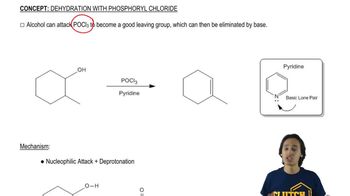
Dehydration reactions involve the removal of water (H2O) from a molecule, often leading to the formation of double bonds or new functional groups. In this case, after the nucleophilic attack by ethylamine on the carbonyl compound, the subsequent loss of water results in the formation of an imine. Understanding dehydration is key to predicting the final product of the reaction, especially in the context of carbonyl chemistry.
Video consigliato:
01:23
General Reaction of Dehydration with POCl3