Ch. 19 - Amines
Wade - Organic Chemistry 9th Edition
Wade9th EditionOrganic ChemistryISBN: 9780135213728Non è quello che usi tu?Cambia libro di testo
Capitolo 19, Problema 12

Propose a mechanism for the sulfonation of pyridine, and point out why sulfonation occurs at the 3-position.

Guida verificata passo dopo passo
1
Step 1: Recognize that sulfonation of pyridine involves electrophilic aromatic substitution. The electrophile in this reaction is the sulfur trioxide (SO₃) molecule, which is generated from fuming sulfuric acid (H₂SO₄). The reaction occurs under high temperature (230 °C) to overcome pyridine's reduced reactivity due to the electron-withdrawing nitrogen atom.
Step 2: Analyze the electronic structure of pyridine. The nitrogen atom in pyridine is electronegative and withdraws electron density from the ring, making the ring less reactive toward electrophiles. Additionally, the nitrogen's lone pair is not delocalized into the aromatic system, further reducing the ring's electron density.
Step 3: Consider the regioselectivity of the sulfonation. Electrophilic substitution on pyridine typically occurs at the 3-position because the 2- and 4-positions are destabilized by the positive charge that would result on the nitrogen atom in the intermediate resonance structures. Substitution at the 3-position avoids this destabilization.
Step 4: Propose the mechanism. First, the sulfur trioxide (SO₃) electrophile attacks the 3-position of pyridine, forming a sigma complex (arenium ion). This intermediate is stabilized by resonance, avoiding structures that place a positive charge on the nitrogen atom.
Step 5: Complete the reaction. The sigma complex undergoes deprotonation to restore aromaticity, resulting in the formation of 3-sulfonated pyridine. The sulfonic acid group (-SO₃H) is attached at the 3-position, as shown in the product structure.

Risposta video verificata per un problema simile:

Questa soluzione video è stata consigliata dai nostri tutor come utile per risolvere questo problema.
Durata del video:
7m

Concetti chiave

Ecco i concetti essenziali che devi comprendere per rispondere correttamente alla domanda.

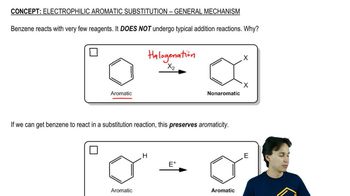
Electrophilic Aromatic Substitution (EAS)

Electrophilic Aromatic Substitution is a fundamental reaction mechanism in organic chemistry where an electrophile replaces a hydrogen atom on an aromatic ring. In the case of pyridine, the nitrogen atom's lone pair can influence the reactivity and orientation of the substitution, making it crucial to understand how electrophiles interact with the aromatic system.
Video consigliato:
03:07
EAS Review

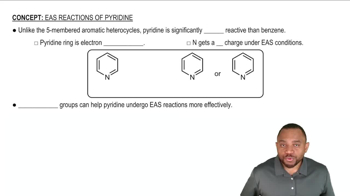
Pyridine Structure and Reactivity

Pyridine is a six-membered aromatic ring containing a nitrogen atom, which affects its electronic properties. The nitrogen atom is electron-withdrawing, which alters the electron density on the ring and influences the position where electrophilic substitution occurs. Understanding the electronic effects of the nitrogen is essential for predicting the site of sulfonation.
Video consigliato:
Percorso guidato
1:33
EAS Reactions of Pyridine Concept 1

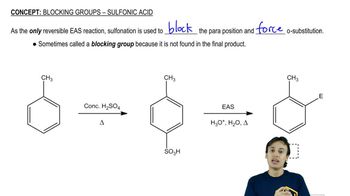
Regioselectivity in Sulfonation

Regioselectivity refers to the preference of a chemical reaction to occur at one site over another in a molecule. In the sulfonation of pyridine, the 3-position is favored due to the resonance stabilization of the intermediate cation formed during the reaction. This concept is vital for explaining why sulfonation predominantly occurs at this position rather than others.
Video consigliato:
04:33
Forcing Ortho substitution