Ch. 19 - Amines
Wade - Organic Chemistry 9th Edition
Wade9th EditionOrganic ChemistryISBN: 9780135213728Non è quello che usi tu?Cambia libro di testo
Capitolo 19, Problema 14b

(b) When 3-bromopyridine is used in this reaction, stronger reaction conditions are required and a mixture of 3-aminopyridine and 4-aminopyridine results. Propose a mechanism to explain this curious result.

Guida verificata passo dopo passo
1
Identify the reaction type: The problem involves the conversion of 3-bromopyridine to a mixture of 3-aminopyridine and 4-aminopyridine. This suggests a nucleophilic aromatic substitution (NAS) mechanism, which is common for halogenated aromatic compounds under strong conditions.
Analyze the structure of 3-bromopyridine: The bromine atom is attached to the 3-position of the pyridine ring. Pyridine is an electron-deficient aromatic ring due to the electronegativity of the nitrogen atom, which makes it susceptible to nucleophilic attack under appropriate conditions.
Propose the first step of the mechanism: Under strong reaction conditions, the nucleophile (likely an amine or ammonia) attacks the 3-position of the pyridine ring, displacing the bromine atom. This occurs via an addition-elimination mechanism, where the nucleophile adds to the ring, forming a Meisenheimer complex (an intermediate with a negatively charged aromatic ring).
Explain the formation of 4-aminopyridine: The strong reaction conditions can lead to rearrangement of the intermediate. The negative charge in the Meisenheimer complex can delocalize, allowing the nucleophile to migrate to the 4-position of the pyridine ring. This results in the formation of 4-aminopyridine as a side product.
Conclude with the product mixture: The reaction conditions favor both direct substitution at the 3-position and rearrangement to the 4-position, leading to a mixture of 3-aminopyridine and 4-aminopyridine. The ratio of these products depends on the reaction conditions, such as temperature, solvent, and nucleophile concentration.

Risposta video verificata per un problema simile:

Questa soluzione video è stata consigliata dai nostri tutor come utile per risolvere questo problema.
Durata del video:
8m

Concetti chiave

Ecco i concetti essenziali che devi comprendere per rispondere correttamente alla domanda.

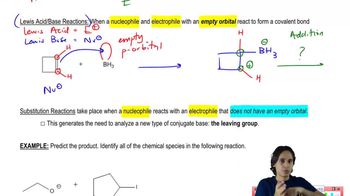
Nucleophilic Substitution

Nucleophilic substitution is a fundamental reaction in organic chemistry where a nucleophile attacks an electrophile, replacing a leaving group. In the case of 3-bromopyridine, the bromine atom acts as a leaving group, and the reaction conditions influence the nucleophile's ability to attack the aromatic ring, leading to the formation of different products.
Video consigliato:
01:47
Nucleophiles and Electrophiles can react in Substitution Reactions.

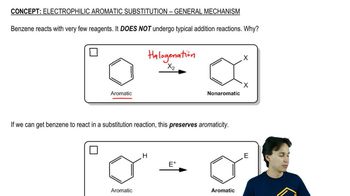
Aromaticity and Electrophilic Substitution

Aromatic compounds, like pyridine, exhibit unique stability due to their delocalized π-electron systems. Electrophilic substitution reactions in aromatic systems can lead to regioselectivity, where the position of substitution is influenced by the electronic effects of substituents. In this case, the presence of the bromine atom affects the reactivity and orientation of the nucleophile.
Video consigliato:
03:07
EAS Review

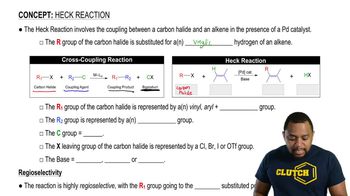
Regioselectivity

Regioselectivity refers to the preference of a chemical reaction to yield one structural isomer over others when multiple possibilities exist. In the reaction involving 3-bromopyridine, the formation of both 3-aminopyridine and 4-aminopyridine suggests that the nucleophile can attack at different positions on the aromatic ring, influenced by steric and electronic factors, leading to a mixture of products.
Video consigliato:
05:09
Heck Reaction