Ch. 20 - Carboxylic Acids
Wade - Organic Chemistry 9th Edition
Wade9th EditionOrganic ChemistryISBN: 9780135213728Non è quello che usi tu?Cambia libro di testo
Capitolo 20, Problema 37b

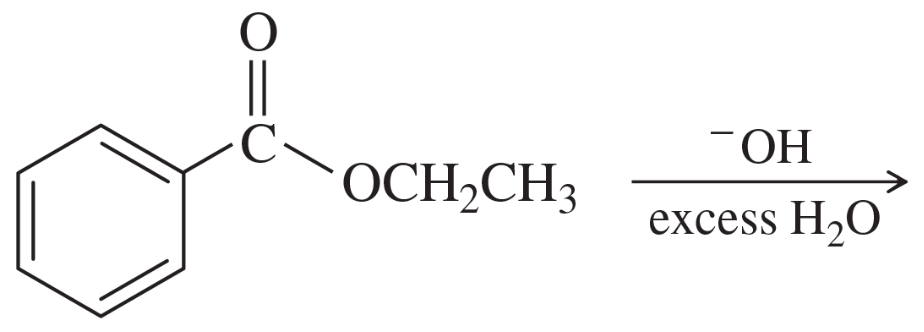
Predict the products and propose mechanisms for the following reactions.
(b)

Guida verificata passo dopo passo
1
Step 1: Analyze the reactant structure. The given compound is an ester, specifically methyl benzoate, which contains a benzene ring attached to a carboxylic acid ester functional group (-COOCH3). The reaction conditions involve hydroxide ions (OH⁻) in water, indicating a base-catalyzed hydrolysis reaction.
Step 2: Understand the reaction mechanism. Base-catalyzed hydrolysis of esters proceeds through nucleophilic attack by the hydroxide ion (OH⁻) on the carbonyl carbon of the ester group. This forms a tetrahedral intermediate.
Step 3: Break down the intermediate. The tetrahedral intermediate collapses, leading to the cleavage of the ester bond. The methoxide ion (CH3O⁻) is expelled as a leaving group, and a carboxylate ion (-COO⁻) is formed.
Step 4: Finalize the product formation. In the aqueous environment, the carboxylate ion reacts with water to form benzoic acid (C6H5COOH) as the final product. The methoxide ion (CH3O⁻) may also react with water to form methanol (CH3OH).
Step 5: Summarize the reaction. The base-catalyzed hydrolysis of methyl benzoate under OH⁻/H2O conditions results in the formation of benzoic acid and methanol as the products.

Risposta video verificata per un problema simile:

Questa soluzione video è stata consigliata dai nostri tutor come utile per risolvere questo problema.
Durata del video:
5m

Concetti chiave

Ecco i concetti essenziali che devi comprendere per rispondere correttamente alla domanda.

Saponification

Saponification is a chemical reaction that involves the hydrolysis of esters in the presence of a strong base, typically sodium hydroxide (NaOH) or potassium hydroxide (KOH). In this process, an ester reacts with hydroxide ions to produce an alcohol and a carboxylate salt. This reaction is commonly associated with the production of soap from fats and oils, where the ester bonds are broken down to yield fatty acid salts.
Video consigliato:
03:27
Mechanism

Mechanism of Nucleophilic Substitution

The mechanism of nucleophilic substitution involves the attack of a nucleophile on an electrophilic carbon atom, leading to the displacement of a leaving group. In the case of saponification, the hydroxide ion acts as the nucleophile, attacking the carbonyl carbon of the ester. This results in the formation of a tetrahedral intermediate, which subsequently collapses to release the alcohol and form the carboxylate ion.
Video consigliato:
01:47
Nucleophiles and Electrophiles can react in Substitution Reactions.

Role of Hydroxide Ion

The hydroxide ion (OH-) plays a crucial role in saponification as a strong nucleophile that initiates the reaction. Its high electron density allows it to effectively attack the electrophilic carbon of the ester, facilitating the cleavage of the ester bond. The presence of water in the reaction medium also aids in the hydrolysis process, ensuring that the products are formed efficiently and that the reaction reaches completion.
Video consigliato:
Percorso guidato
3:39
Metal Ion Catalysis Concept 1