Ch. 20 - Carboxylic Acids
Wade - Organic Chemistry 9th Edition
Wade9th EditionOrganic ChemistryISBN: 9780135213728Non è quello che usi tu?Cambia libro di testo
Capitolo 20, Problema 37d

Predict the products and propose mechanisms for the following reactions.
(d)

Guida verificata passo dopo passo
1
Analyze the given reaction: Identify the type of reaction (e.g., substitution, elimination, addition, etc.) based on the reactants, reagents, and conditions provided. Look for functional groups and any specific reagents that indicate the reaction pathway.
Predict the products: Based on the reaction type, determine the possible products. For example, if the reaction involves a nucleophilic substitution, consider whether it follows an SN1 or SN2 mechanism. If it involves elimination, determine whether it is E1 or E2.
Propose the mechanism: Break down the reaction into individual steps. For example, if it is an SN1 reaction, describe the formation of the carbocation intermediate and the subsequent attack by the nucleophile. Use curved arrows to show the movement of electrons.
Consider stereochemistry: If the reaction involves chiral centers or stereochemical outcomes, analyze whether the product will be racemic, retain configuration, or invert configuration. This depends on the mechanism (e.g., SN2 leads to inversion of configuration).
Verify the reaction conditions: Ensure that the proposed mechanism and products are consistent with the reagents and conditions provided in the problem. For example, strong bases favor elimination (E2), while polar protic solvents favor SN1 reactions.

Risposta video verificata per un problema simile:

Questa soluzione video è stata consigliata dai nostri tutor come utile per risolvere questo problema.
Durata del video:
1m

Concetti chiave

Ecco i concetti essenziali che devi comprendere per rispondere correttamente alla domanda.

Reaction Mechanisms

Reaction mechanisms describe the step-by-step process by which reactants transform into products. Understanding these mechanisms involves identifying the intermediates, transition states, and the sequence of bond-breaking and bond-forming events. This knowledge is crucial for predicting the products of a reaction and understanding the underlying chemistry.
Video consigliato:
02:16
Heck Reaction Mechanism

Types of Organic Reactions

Organic reactions can be classified into several types, including substitution, addition, elimination, and rearrangement reactions. Each type has distinct characteristics and mechanisms. Recognizing the type of reaction occurring helps in predicting the products and understanding the conditions under which the reaction takes place.
Video consigliato:
07:37
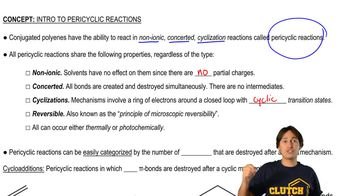
Properties and Types of Pericyclic Reactions

Functional Groups

Functional groups are specific groups of atoms within molecules that are responsible for the characteristic chemical reactions of those molecules. Identifying functional groups in reactants is essential for predicting the products of a reaction, as they dictate reactivity and the types of transformations that can occur during the reaction.
Video consigliato:
02:36
Identifying Functional Groups