Ch. 20 - Carboxylic Acids
Wade - Organic Chemistry 9th Edition
Wade9th EditionOrganic ChemistryISBN: 9780135213728Non è quello che usi tu?Cambia libro di testo
Capitolo 20, Problema 23a

Propose mechanisms for the nucleophilic acyl substitutions to form ethyl benzoate as shown on the previous page.

Guida verificata passo dopo passo
1
Step 1: Identify the reactants and products. The reactant is benzoyl chloride (PhCOCl), and the product is ethyl benzoate (PhCOOCH3). The reaction involves nucleophilic acyl substitution, where the chlorine atom is replaced by a methoxy group (-OCH3).
Step 2: Recognize the role of pyridine. Pyridine acts as a base to neutralize the HCl formed during the reaction, preventing the reaction medium from becoming too acidic and facilitating the substitution process.
Step 3: Initiate the mechanism. Methanol (CH3OH) acts as the nucleophile. The lone pair of electrons on the oxygen atom of methanol attacks the carbonyl carbon of benzoyl chloride, forming a tetrahedral intermediate. This step is driven by the electrophilic nature of the carbonyl carbon due to the electron-withdrawing effect of the chlorine atom.
Step 4: Collapse of the tetrahedral intermediate. The tetrahedral intermediate undergoes rearrangement, where the chlorine atom is expelled as a leaving group. This results in the formation of the ester bond (PhCOOCH3).
Step 5: Neutralization by pyridine. Pyridine reacts with the HCl generated during the substitution, forming pyridinium chloride. This prevents the accumulation of HCl and stabilizes the reaction environment.

Risposta video verificata per un problema simile:

Questa soluzione video è stata consigliata dai nostri tutor come utile per risolvere questo problema.
Durata del video:
2m

Concetti chiave

Ecco i concetti essenziali che devi comprendere per rispondere correttamente alla domanda.

Nucleophilic Acyl Substitution

Nucleophilic acyl substitution is a fundamental reaction in organic chemistry where a nucleophile attacks the carbonyl carbon of an acyl compound, leading to the replacement of a leaving group. This mechanism typically involves the formation of a tetrahedral intermediate, which then collapses to regenerate the carbonyl and expel the leaving group. Understanding this process is crucial for predicting the products of reactions involving acyl compounds.
Video consigliato:
01:47
Nucleophiles and Electrophiles can react in Substitution Reactions.

Role of Pyridine

Pyridine is often used as a base and a catalyst in nucleophilic acyl substitution reactions. It can deprotonate the nucleophile, enhancing its nucleophilicity, and stabilize the tetrahedral intermediate formed during the reaction. Additionally, pyridine can help facilitate the departure of the leaving group, making the reaction more efficient. Recognizing the role of pyridine is essential for understanding the mechanism of the reaction leading to ethyl benzoate.
Video consigliato:
Percorso guidato
1:07
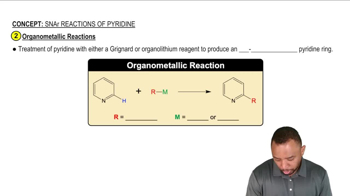
SNAr Reactions of Pyridine Concept 2

Formation of Ethyl Benzoate

Ethyl benzoate is an ester formed from the reaction of benzoic acid and ethanol, typically through nucleophilic acyl substitution. In this context, the reaction involves the nucleophilic attack of the ethoxide ion (from ethanol) on the carbonyl carbon of the acyl chloride, leading to the formation of the ester bond. Understanding the specific steps and intermediates in this transformation is key to proposing a detailed mechanism for the synthesis of ethyl benzoate.
Video consigliato:
02:26
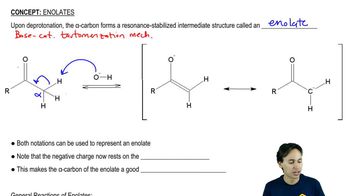
Formation of Enolates