Ch. 20 - Carboxylic Acids
Wade - Organic Chemistry 9th Edition
Wade9th EditionOrganic ChemistryISBN: 9780135213728Non è quello che usi tu?Cambia libro di testo
Capitolo 20, Problema 21b

Show how the following ketones might be synthesized from the indicated acids, using any necessary reagents.
(b) methyl cyclohexyl ketone from cyclohexanecarboxylic acid

Guida verificata passo dopo passo
1
Step 1: Recognize that the transformation involves converting a carboxylic acid (cyclohexanecarboxylic acid) into a ketone (methyl cyclohexyl ketone). This typically requires a decarboxylation step followed by an alkylation reaction.
Step 2: Begin by converting the carboxylic acid group (-COOH) into an acyl chloride (-COCl). This can be achieved using reagents such as thionyl chloride (SOCl₂) or oxalyl chloride. The reaction proceeds as: R-COOH+SOCl2→R-COCl+HCl+SO2.
Step 3: Perform a Friedel-Crafts acylation reaction to introduce the methyl group. React the acyl chloride with methylbenzene (toluene) in the presence of a Lewis acid catalyst such as aluminum chloride (AlCl₃). This step forms the desired ketone: R-COCl+CH3−AlCl→....

Risposta video verificata per un problema simile:

Questa soluzione video è stata consigliata dai nostri tutor come utile per risolvere questo problema.
Durata del video:
8m

Concetti chiave

Ecco i concetti essenziali che devi comprendere per rispondere correttamente alla domanda.

Ketone Synthesis

Ketones can be synthesized through various methods, including oxidation of secondary alcohols, Friedel-Crafts acylation, and the reaction of carboxylic acids with organometallic reagents. Understanding these pathways is crucial for determining how to convert a given acid into a ketone. In this case, the transformation of cyclohexanecarboxylic acid into methyl cyclohexyl ketone requires knowledge of the appropriate reagents and reaction conditions.
Video consigliato:
02:27
Name the ketone

Carboxylic Acids

Carboxylic acids are organic compounds characterized by the presence of a carboxyl group (-COOH). They serve as important starting materials in organic synthesis due to their reactivity, particularly in nucleophilic acyl substitution reactions. In the context of this question, cyclohexanecarboxylic acid is the precursor that will undergo transformation to yield the desired ketone.
Video consigliato:
04:20
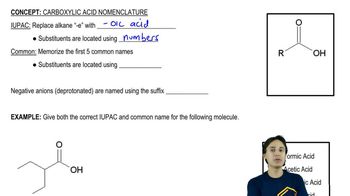
Carboxylic Acids Nomenclature

Nucleophilic Acyl Substitution

Nucleophilic acyl substitution is a fundamental reaction mechanism in organic chemistry where a nucleophile attacks the carbonyl carbon of a carboxylic acid derivative, leading to the substitution of the leaving group. This mechanism is essential for converting carboxylic acids into ketones, as it allows for the introduction of new alkyl groups. Understanding this mechanism will help in planning the synthesis of methyl cyclohexyl ketone from cyclohexanecarboxylic acid.
Video consigliato:
01:47
Nucleophiles and Electrophiles can react in Substitution Reactions.