
Ch. 21 - Carboxylic Acid Derivatives
Wade - Organic Chemistry 9th Edition
Wade9th EditionOrganic ChemistryISBN: 9780135213728Non è quello che usi tu?Cambia libro di testo
Capitolo 21, Problema 66

An unknown compound gives a mass spectrum with a weak molecular ion at m/z 113 and a prominent ion at m/z 68. Its NMR and IR spectra are shown here. Determine the structure, and show how it is consistent with the observed absorptions. Propose a favorable fragmentation to explain the prominent MS peak at m/z 68.
<IMAGE>

Guida verificata passo dopo passo
1
Analyze the molecular ion peak at m/z 113. This peak represents the molecular weight of the compound. Consider possible molecular formulas that match this molecular weight, keeping in mind the presence of common elements like C, H, O, and N.
Examine the IR spectrum to identify functional groups. Look for characteristic absorption bands, such as those for O-H (broad peak around 3200-3600 cm⁻¹), C=O (sharp peak around 1700 cm⁻¹), or C-H (peaks around 2800-3100 cm⁻¹). Note any significant absorptions that can help narrow down the functional groups present in the compound.
Interpret the NMR spectrum to determine the hydrogen environment. Look for the number of signals, their chemical shifts, splitting patterns, and integration values. This will provide information about the number of unique hydrogen environments and their connectivity in the molecule.
Propose a structure that is consistent with the molecular ion peak (m/z 113), the functional groups identified from the IR spectrum, and the hydrogen environments deduced from the NMR spectrum. Ensure the structure matches the molecular formula and accounts for all observed spectral data.
Explain the prominent MS peak at m/z 68 by proposing a favorable fragmentation pathway. Identify a bond in the proposed structure that could break to produce a stable fragment with a mass of 68. Consider the stability of carbocations, radicals, or other intermediates formed during fragmentation.

Risposta video verificata per un problema simile:

Questa soluzione video è stata consigliata dai nostri tutor come utile per risolvere questo problema.
Durata del video:
9m

Concetti chiave

Ecco i concetti essenziali che devi comprendere per rispondere correttamente alla domanda.

Mass Spectrometry (MS)

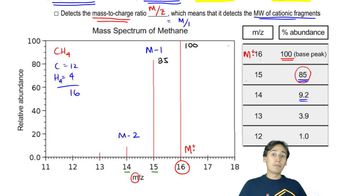
Mass spectrometry is an analytical technique used to measure the mass-to-charge ratio of ions. In this context, the molecular ion peak at m/z 113 indicates the molecular weight of the compound, while the prominent peak at m/z 68 suggests a fragment ion. Understanding how compounds fragment in MS helps in deducing the structure of the original molecule.
Video consigliato:
01:25
How to Read a Mass Spectrum

Nuclear Magnetic Resonance (NMR) Spectroscopy

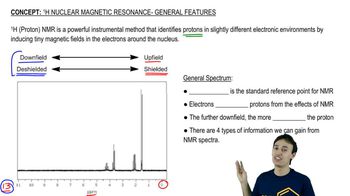
NMR spectroscopy is a powerful tool for determining the structure of organic compounds by analyzing the magnetic properties of atomic nuclei. The chemical shifts and splitting patterns in the NMR spectrum provide information about the environment of hydrogen atoms in the molecule, which aids in confirming the proposed structure consistent with the mass spectrum.
Video consigliato:
10:06
General NMR Features

Infrared (IR) Spectroscopy

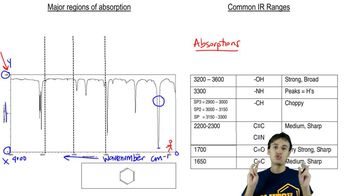
IR spectroscopy is used to identify functional groups in organic compounds by measuring the absorption of infrared light, which causes molecular vibrations. The specific absorption bands in the IR spectrum correlate with particular bonds and functional groups, providing additional structural information that supports the analysis derived from MS and NMR data.
Video consigliato:
16:04
General Features of IR Spect
Pratica correlata
Domanda del libro di testo

Macrolide antibiotics, including erythromycin and azithromycin (Zithromax®), contain a large ring lactone. One of the largest ever reported is Gargantulide A, the structure of which was determined by the research group of Prof. William Gerwick of the Scripps Institution of Oceanography (Organic Letters, 2015, 17, 1377–1380). Isolated from a Streptomyces bacterium, it kills pathogenic bacteria like MRSA and Clostridium difficile, but it proved too toxic to the test animals to continue further testing.

(a) Identify the lactone that makes this a macrolide structure.

(b) How many rings does this structure contain? How many atoms are in the largest ring?

1001
views
Domanda del libro di testo

The structures of four useful polymers are shown, together with some of their best-known products. In each case,

(i) Determine the kind of polymer (polyamide, polyester, etc.).

(ii) Draw the structures of the monomers that would be released by complete hydrolysis.

(iii) Suggest what monomers or stable derivatives of the monomers might be used to make these polymers.

(a)

682
views
Domanda del libro di testo

The structures of four useful polymers are shown, together with some of their best-known products. In each case,

(i) determine the kind of polymer (polyamide, polyester, etc.).

(c)

(d)

706
views
Domanda del libro di testo

The structures of four useful polymers are shown, together with some of their best-known products. In each case,

(i) Determine the kind of polymer (polyamide, polyester, etc.).

(ii) Draw the structures of the monomers that would be released by complete hydrolysis.

(iii) Suggest what monomers or stable derivatives of the monomers might be used to make these polymers.

(b)

716
views